
At Google I/O 2026, Google announced that AI Mode had surpassed one billion monthly users, with queries more than doubling every quarter since launch, and confirmed Gemini 3.5 Flash as the new default model in AI Mode globally.[1] Google also described its redesigned Search box as the biggest upgrade to Search input in more than 25 years, with support for longer prompts, follow-up questions, and multimodal inputs such as images, files, videos, and Chrome tabs.[1]
For online businesses, this is not simply another SERP feature to monitor. It changes where commercial discovery begins. The practical SEO question is no longer only, "Can we rank on page one?" It is also, "Can AI systems understand, trust, and cite our business when they synthesise an answer?" That distinction matters because AI search compresses research, comparison, and recommendation into the search interface itself.
Google's own guidance is direct: SEO remains relevant for generative AI search because Google's AI features are rooted in its core Search ranking and quality systems.[2] The implication is not that SEO is dead. The implication is that weak SEO is becoming easier to ignore. If a business relies on generic content, thin comparison pages, unclear product data, or JavaScript-heavy pages that hide important information, AI-first discovery will make those weaknesses more visible.
The Shift From Keywords to Research Briefs
Traditional search encouraged users to condense intent into short queries. AI search encourages users to describe the problem in full. Search Engine Journal's coverage of Google's AI Mode data reports that AI Mode queries are roughly three times as long as traditional searches, follow-up queries are growing, and more than 16% of AI Mode searches are multimodal.[3]
This means a user is less likely to search only for "SEO agency" and more likely to ask, "Which SEO agency can help a Shopify brand recover from a traffic drop after the May 2026 core update while improving AI Overview visibility?" That shift turns SEO content into evidence. A business must prove that it is relevant to complex, layered intent. Pages that answer only one keyword variation may underperform in a world where Google's systems use query fan-out - generating concurrent related searches to collect additional information for complex queries.[2]
| Old search behaviour | AI-first search behaviour | Business implication |
|---|---|---|
| Short, keyword-led searches | Longer, conversational prompts | Content must address real decision scenarios, not isolated keywords. |
| One query, one SERP | Follow-up questions and context retention | Brands need topic depth across interconnected pages. |
| Text-only intent | Multimodal prompts using images, files, video, or tabs | Visual assets, product data, and page clarity become part of discoverability. |
| Clicks as the main success metric | Visibility, citations, and assisted decisions | SEO reporting must track more than organic sessions alone. |
This is especially important for ecommerce, SaaS, professional services, local businesses, and B2B firms. When buyers use AI search to compare vendors, shortlist providers, or validate trust, the model is performing part of the evaluation journey before the user ever lands on a website.
Why Generic Content Is Losing Defensive Value

Google's AI optimisation guide places strong emphasis on non-commodity content. Google specifically contrasts generic articles that could be written by anyone with content that reflects original experience, unique viewpoints, and practical expertise.[2] That aligns with a broader market reality: AI systems can easily summarise common knowledge, but they still need authoritative source material for distinctive insight.
PYMNTS makes a similar point in its analysis of Google's AI Mode for B2B discovery, arguing that the competition is shifting from being visible in a ranked list to being incorporated into synthesised answers.[4] The article notes that AI discovery tends to reward corroboration, structured information, semantic consistency, and repeated references across trusted sources.[4]
For online businesses, this means the next stage of content marketing is not about publishing more generic explainers. It is about publishing information competitors cannot easily copy - original customer insights, proprietary benchmarks, detailed case studies, product comparisons based on real data, industry-specific implementation notes, and transparent service criteria.
| Content asset | Why it matters in AI search | Example for an online business |
|---|---|---|
| Proprietary research | Gives AI systems unique source material to cite | "2026 Conversion Benchmark Report for UK Shopify Stores" |
| First-hand case studies | Demonstrates experience and outcome evidence | "How We Rebuilt a Lead Gen Site After a Core Update" |
| Clear product or service data | Reduces ambiguity for AI comparison tasks | Pricing, availability, integrations, guarantees, service areas |
| Expert commentary | Builds topical authority beyond commodity advice | Founder analysis of Google AI Mode's impact on B2B SEO |
| Structured FAQs | Captures high-intent conversational questions | "Can AI Overviews reduce ecommerce organic traffic?" |
The businesses that win will not necessarily be those that publish the most. They will be the businesses that create the clearest, most trustworthy, and most differentiated source material.
Technical SEO Still Decides Whether AI Can Use the Page
Google's official guidance is useful because it cuts through much of the current AI SEO noise. Google says there is no special requirement to create llms.txt, break content into tiny chunks, rewrite pages specifically for AI systems, chase inauthentic mentions, or add special schema solely for generative AI search.[2] It also says structured data is not required for generative AI search, although it remains useful for rich results and the wider SEO strategy.[2]
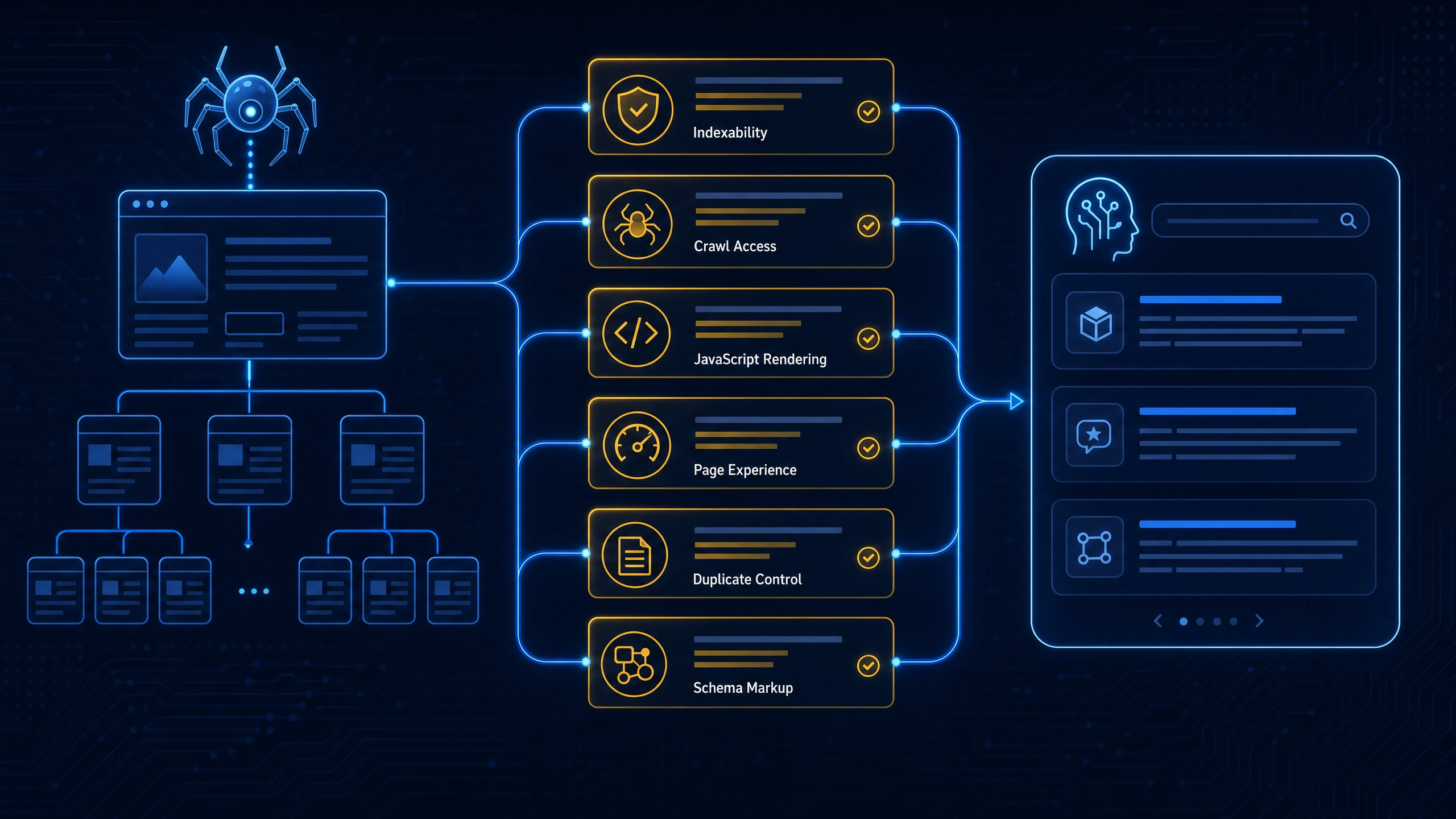
That does not mean technical SEO is less important. It means foundational technical SEO is more important. Google states that pages must be indexed and eligible to show a snippet to appear in generative AI features, and it continues to recommend crawlability, JavaScript SEO best practices, page experience, semantic HTML where practical, and duplicate content reduction.[2]
In plain terms, if Google cannot reliably crawl, render, understand, and index a business's most important pages, AI search will not rescue that business. AI Mode is built on top of the same discovery infrastructure that already rewards technical clarity.
| Technical priority | What to check | Why it matters now |
|---|---|---|
| Indexability | Confirm priority pages are indexed and snippet-eligible. | AI features draw from Google's Search index.[2] |
| Crawl access | Avoid blocking key content, assets, product details, and scripts. | AI systems need publicly accessible content to ground responses.[2] |
| JavaScript rendering | Ensure important copy, links, and product data are visible after rendering. | JavaScript-heavy sites are harder to optimise if content is delayed or hidden.[2] |
| Page experience | Improve performance, mobile usability, and layout clarity. | Users who do click through must be able to evaluate and convert quickly. |
| Duplicate control | Consolidate thin, duplicate, or near-identical pages. | Duplicates can waste crawl resources and weaken canonical signals.[2] |
| Blog schema | Add complete BlogPosting schema for articles. | Schema supports rich results and makes article metadata unambiguous. |
For web development teams, the practical takeaway is that AI SEO should not sit separately from technical implementation. Search visibility now depends on the partnership between content strategy, front-end performance, structured information, and crawl-friendly architecture.
The May 2026 Core Update Complicates Measurement
The timing of Google's May 2026 core update makes measurement more complex. Search Engine Journal reports that Google began rolling out the May 2026 core update on 21 May, describing it as the second core update of 2026 and noting that the rollout may take up to two weeks.[3] Because this update overlaps with major AI Search announcements, businesses should avoid rushing to attribute traffic changes to a single cause.
The right approach is disciplined benchmarking. Compare pre-update Search Console data against performance after the rollout has completed, then wait long enough for the data to settle before making strategic decisions. If organic sessions decline but branded visibility, AI citations, or assisted conversions improve, the business may be seeing a shift in user behaviour rather than a simple ranking loss.
This is where SEO reporting needs to evolve. Organic clicks still matter, but they no longer tell the full story. Online businesses should begin monitoring brand mentions in AI search tools, visibility for high-intent conversational prompts, referral quality, conversion-assisted pages, and query patterns that show research-stage demand.
Is Your Site Visible to AI Search?
Get a free AI SEO audit from Think SEO. We'll identify exactly where your site stands against Google's current AI search signals - and give you a clear action plan to improve your visibility, citations, and rankings.
Get Your Free AI SEO AuditWhat Online Businesses Should Do Next
The strongest response is not to chase every new AI optimisation tactic. It is to improve the quality of the signals that AI systems and human buyers already need. Start by auditing the pages that represent commercial intent: service pages, product pages, comparison pages, pricing pages, category pages, and case studies. These pages should clearly explain who the offer is for, what problem it solves, what evidence supports it, where it is available, and what the next step is.
Then build content around decision-stage questions rather than keyword fragments. AI search is well suited to prompts that compare options, evaluate trade-offs, and summarise recommendations. A business that publishes clear comparison content, transparent buying guides, implementation checklists, and original research gives AI systems more useful material to work with.
Finally, treat brand authority as a technical and editorial asset. Mentions across reputable publications, industry sites, partner pages, customer stories, and expert commentary can reinforce the broader consensus around a business. The goal is not artificial mention-building - Google explicitly warns against inauthentic mentions for generative AI search.[2] The goal is to become genuinely reference-worthy in the market.
| Priority action | Expected SEO benefit |
|---|---|
| Content differentiation - replace generic posts with original insight, case studies, and proprietary data | Stronger topical authority and higher citation potential. |
| Commercial clarity - make products, services, pricing, locations, and differentiators easy to parse | Better eligibility for comparison and recommendation queries. |
| Technical accessibility - improve crawlability, rendering, internal links, canonical tags, and page speed | Stronger indexing and AI retrieval readiness. |
| Conversational coverage - add pages and sections that answer complex, multi-part buyer questions | Better match for AI Mode-style prompts and query fan-out. |
| Measurement expansion - track visibility, mentions, assisted conversions, and prompt-based discovery | More accurate view of SEO value in a lower-click environment. |
The Bottom Line
AI search is becoming a new homepage for online businesses because it increasingly shapes what users see before they visit a website. Google's direction is clear: Search is becoming more conversational, more multimodal, more agentic, and more capable of completing parts of the research journey inside the interface itself.[1]
The businesses that adapt fastest will not abandon SEO. They will practise better SEO. They will publish fewer commodity articles and more defensible insight. They will make their websites easier to crawl, understand, and trust. They will align web development with search visibility. Most importantly, they will measure success beyond the click - because in AI-first discovery, being selected, cited, and recommended may become just as important as ranking first.
If you want to understand where your site stands in this new landscape, get in touch with Think SEO. Our AI SEO strategy and technical SEO audits are built for exactly this environment.
Sources & References
- [1] Google - A new era for AI Search (Google I/O 2026, 19 May 2026)
- [2] Google Search Central - Optimizing your website for generative AI features on Google Search
- [3] Search Engine Journal - Google Launches Core Update Amid I/O AI Search Overhaul (May 2026)
- [4] PYMNTS - What Google Search's New AI Mode Means for B2B Discovery