Google's New Generative AI Performance Report: What It Means for Your Business in 2026
Google announced dedicated Generative AI Performance Reports in Search Console on 3 June 2026. They provide separate views of impressions in generative AI features for Search and Discover, alongside the overall performance reports. Google confirmed worldwide rollout on 31 August 2026. This guide explains the current reporting scope, its limitations and how to use it alongside traffic and enquiry data.
The change is a dedicated reporting view, not the first time AI-feature activity has contributed to Search Console totals. It helps separate AI impressions for analysis, but does not by itself show the enquiries, revenue or incremental benefit caused by that visibility.
What Is the Google Generative AI Performance Report?
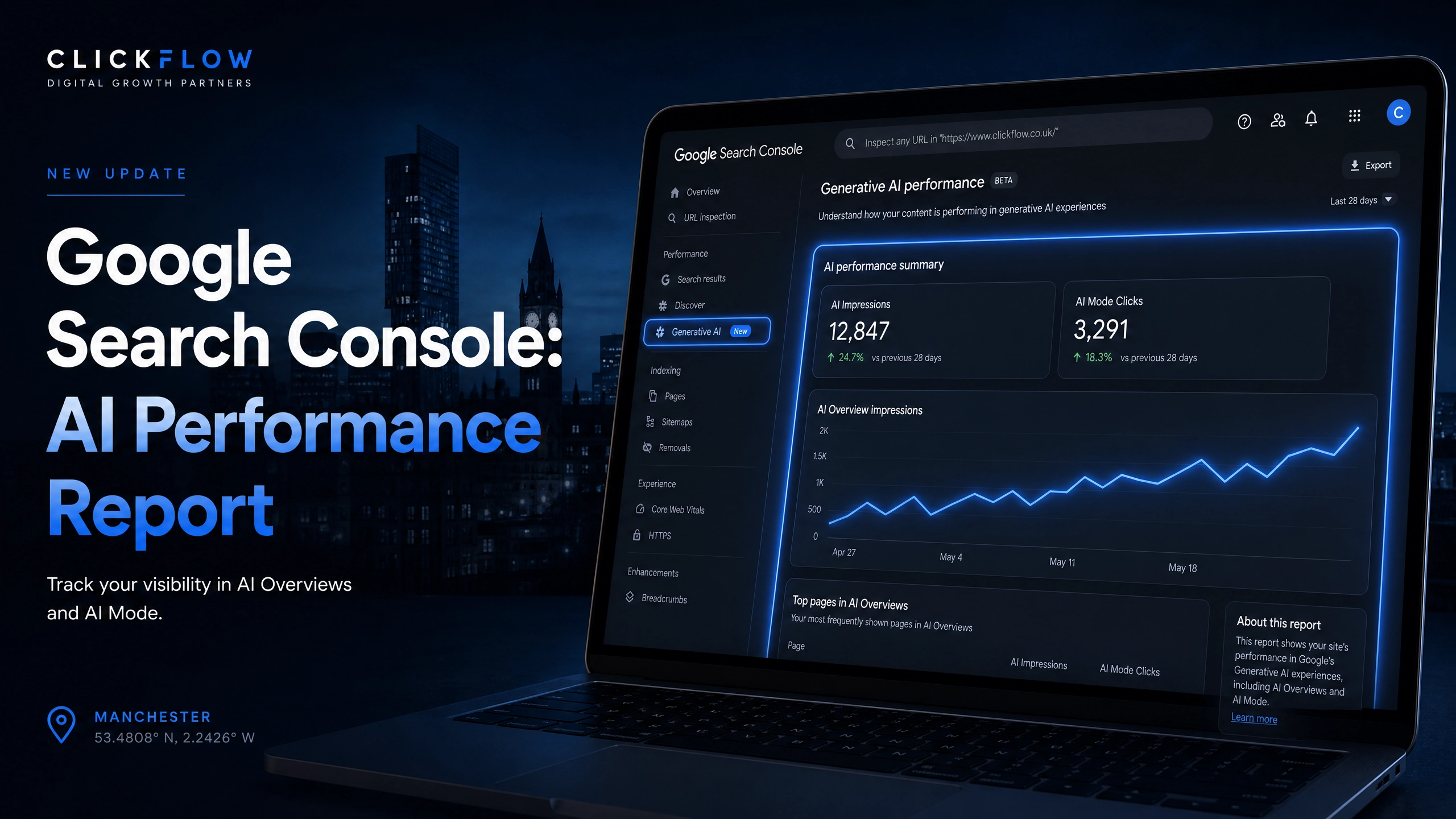
The Generative AI Performance Report is a dedicated section inside Google Search Console's Performance area. It shows how often your pages appear inside Google's AI-powered search features - specifically AI Overviews, AI Mode in Search, and the generative AI features in Discover. Crucially, this data was always being counted in your overall Search Console totals; Google has simply separated it into its own dedicated view so you can finally see it clearly.
Google announced the reports on 3 June 2026 for a subset of websites and confirmed availability worldwide from 31 August 2026. The report may still be absent if a property has not received enough generative AI impressions, including where its content has been excluded from those features. Check Google's current report documentation rather than assuming the property is outside a UK test group.
For businesses that do have access, this report answers the single most important question in modern SEO: are you showing up inside the AI answers that now dominate Google Search?
Why This Report Changes Everything About SEO in 2026
To understand why this matters so profoundly, you need to understand what has happened to Google Search over the past 18 months. AI Overviews now appear in more than 25% of all Google searches - up from roughly 13% just a year ago. AI Mode, Google's fully conversational search interface, has a zero-click rate of approximately 93%, meaning that for nine out of ten AI Mode searches, the user never visits a single website. Across all Google searches, more than 67% now end without a click.
This means that for the majority of searches, the old model - rank in the top three, earn a click, get a visitor - no longer applies. The new model is: be cited in the AI answer, earn brand visibility, build trust before the user ever visits your site.
The dedicated view makes AI impressions easier to examine separately. It cannot diagnose the cause of an organic-click decline on its own. Compare it with the main Search Console performance report, analytics and enquiry records, taking account of query mix, seasonality and website changes.
This is why our AI SEO service has become the fastest-growing area of digital marketing in 2026. Businesses that optimise for AI citation are building a form of visibility that traditional SEO metrics cannot capture - and now, Google is giving you the tools to measure it.
What the Report Actually Shows You
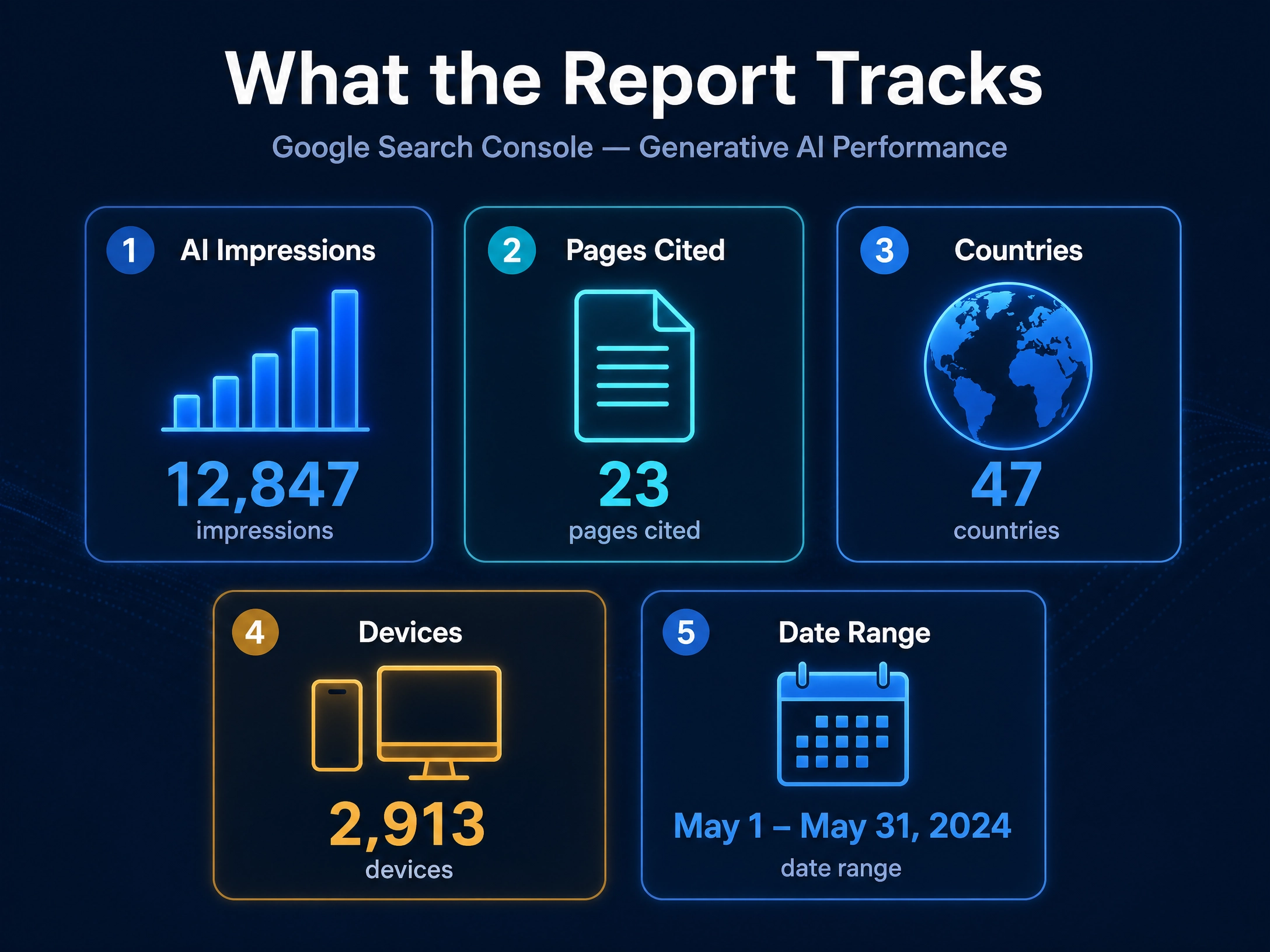
The Generative AI Performance Report provides five dimensions of data, each of which tells a different story about your AI visibility:
AI Impressions are the core metric - how often your URLs appeared inside Google's AI features. This is the headline number that tells you whether Google's AI systems are drawing on your content to answer questions. A page with high AI impressions is being trusted as a source by Google's AI, even if it is not generating clicks.
Pages shows you exactly which URLs are being surfaced inside AI answers. This breakdown is not available anywhere else on the platform, and it is arguably the most valuable dimension in the entire report. In early testing across multiple clients, a consistent pattern emerges: a handful of in-depth guide pages drive the overwhelming majority of AI impressions, while core service pages that rank perfectly well in traditional search barely appear in AI answers at all. This gap is your most actionable data.
Countries gives you your AI visibility broken down by market. For UK businesses, this is particularly valuable because you can now see your AI visibility specifically in your home market rather than a global aggregate. The worldwide rollout means this is no longer a UK-only or early-access advantage.
Devices shows what people were using when your content appeared in AI features - desktop, mobile, or tablet. This dimension applies to Search results only, not Discover.
Dates allows you to view trends from hourly all the way to monthly, giving you the ability to spot inflection points - moments when your AI visibility suddenly increased or decreased - and correlate them with content changes, schema updates, or Google algorithm events.
The Critical Limitation You Need to Know
The dedicated report currently shows impressions, with page, country, date and, for Search, device dimensions. It does not provide clicks, click-through rate or query data. Google says it is working with website owners to consider additional metrics over time; it has not committed to particular extra metrics or a release date.
This means the report answers the question "are we showing up in AI answers?" but not "is that visibility sending us traffic?" Those are two very different questions, and conflating them leads to bad decisions. A page can have thousands of AI impressions and generate zero clicks - because the AI answer resolved the user's question completely. A page with fewer AI impressions but in a more commercial context might generate meaningful click-through.
Treat AI impressions as a visibility metric, not proof of customer trust, traffic or revenue. Establish a baseline and track the trend alongside your main performance report and enquiry data. Review any future reporting additions when Google documents them, rather than assuming click or CTR metrics will arrive.
Two Scoreboards: Why You Now Need to Measure SEO Differently
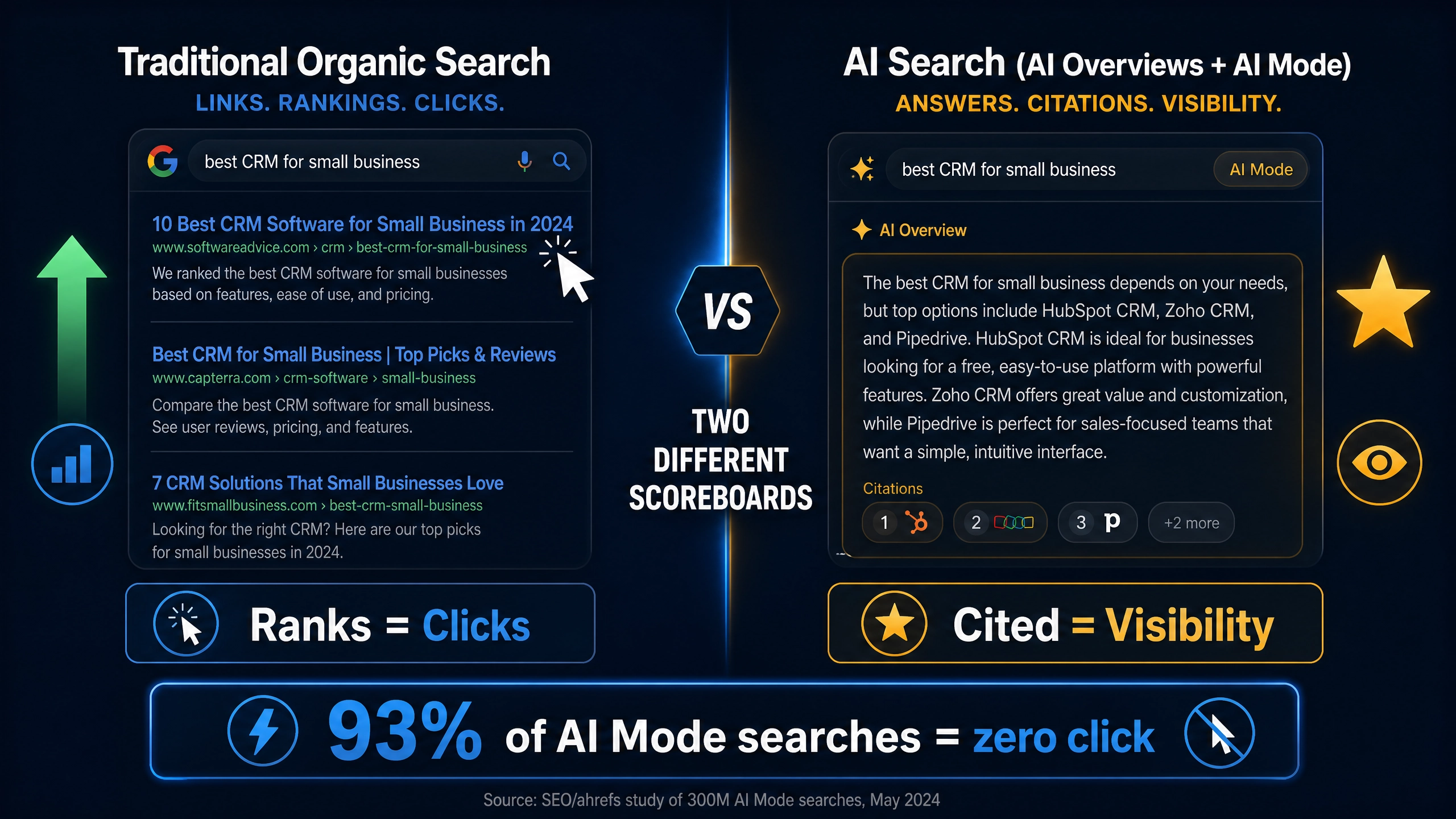
The most important conceptual shift that the Generative AI Performance Report forces is the recognition that SEO now has two completely separate scoreboards.
The first scoreboard is the one you already know: traditional organic performance. Rankings, clicks, click-through rate, conversions. This scoreboard still matters enormously, particularly for commercial and transactional pages where you absolutely need the user to visit your site to generate revenue.
The second scoreboard is AI visibility: impressions inside AI Overviews, AI Mode, and Discover AI. On this scoreboard, being cited in an AI answer is the equivalent of ranking in position one. The user may never click through to your site, but they have seen your business named as an authority on their question. That builds brand recognition, trust, and recall that influences their next search, their next purchase decision, and their recommendation to others.
Businesses that only watch the first scoreboard are now flying half-blind. A page can lose organic clicks month over month while quietly gaining citations inside AI answers - a shift that looks like failure on one scoreboard but is actually a form of success on the other. The Generative AI Performance Report is the tool that lets you see both.
This dual-scoreboard reality is central to our approach to technical SEO and content marketing in 2026. Every piece of content we create and every technical optimisation we make is now evaluated against both sets of criteria: does it rank, and does it get cited?
What Gets Cited in AI Answers: The Patterns That Matter
Early analysis of the Generative AI Performance Report across multiple sites reveals consistent patterns in the content that earns AI citations. Understanding these patterns is the key to improving your AI impressions.
Pages that earn the most AI citations tend to share several characteristics. They provide clear, direct answers near the top of the page - not buried three paragraphs down after a lengthy preamble. They use question-led headings (H2s and H3s phrased as questions) that align precisely with how users phrase their searches. They demonstrate genuine E-E-A-T signals - real author credentials, first-hand experience, specific data points, and proof of expertise rather than generic claims.
Freshness matters more than most SEOs realise. Content can start earning AI impressions within days of publication, but those impressions taper off as the content becomes stale. Pages that are regularly updated with new data, new examples, and new insights maintain their AI citation rate far better than static pages.
Structured content earns a disproportionate share of citations. Analysis of the most-cited URLs in AI answers consistently shows that listicles, comparison tables, and "best X for Y" content formats earn 40–65% of all AI citations, depending on the AI model. This does not mean you should convert all your content into listicles - your commercial service pages need to convert, not just get cited - but it does mean that your informational content should be structured for extractability.
Schema markup is a significant signal. Pages with properly implemented FAQ schema, Article schema, and Service schema are consistently more likely to appear in AI answers than equivalent pages without structured data. This is one of the most actionable improvements you can make immediately. Our technical SEO service includes a full schema audit and implementation as standard.
The Opt-Out Toggle: Should You Use It?
Alongside the new reporting feature, Google also rolled out a control that lets site owners exclude their content from AI Overviews, AI Mode, and Discover AI features. This toggle does not affect your normal organic rankings - it only determines whether your content appears in AI-generated answers.
For the vast majority of businesses, the answer is: leave it on. Opting out means forfeiting all AI impressions and any traffic that does come through AI citations - for no benefit whatsoever to your traditional organic performance. You would be voluntarily stepping out of a growing discovery channel before you even have click data to evaluate whether it is worth being in.
The choice should reflect the business's content rights, distribution policy and commercial objectives rather than a blanket rule. Google confirms that the Search generative AI control rolled out worldwide on 31 August 2026. It governs the listed Search and Discover generative AI features; it is not an AI-training control and does not change ranking or inclusion in other parts of Search.
Your 4-Step Action Plan: How to Use the Report Right Now
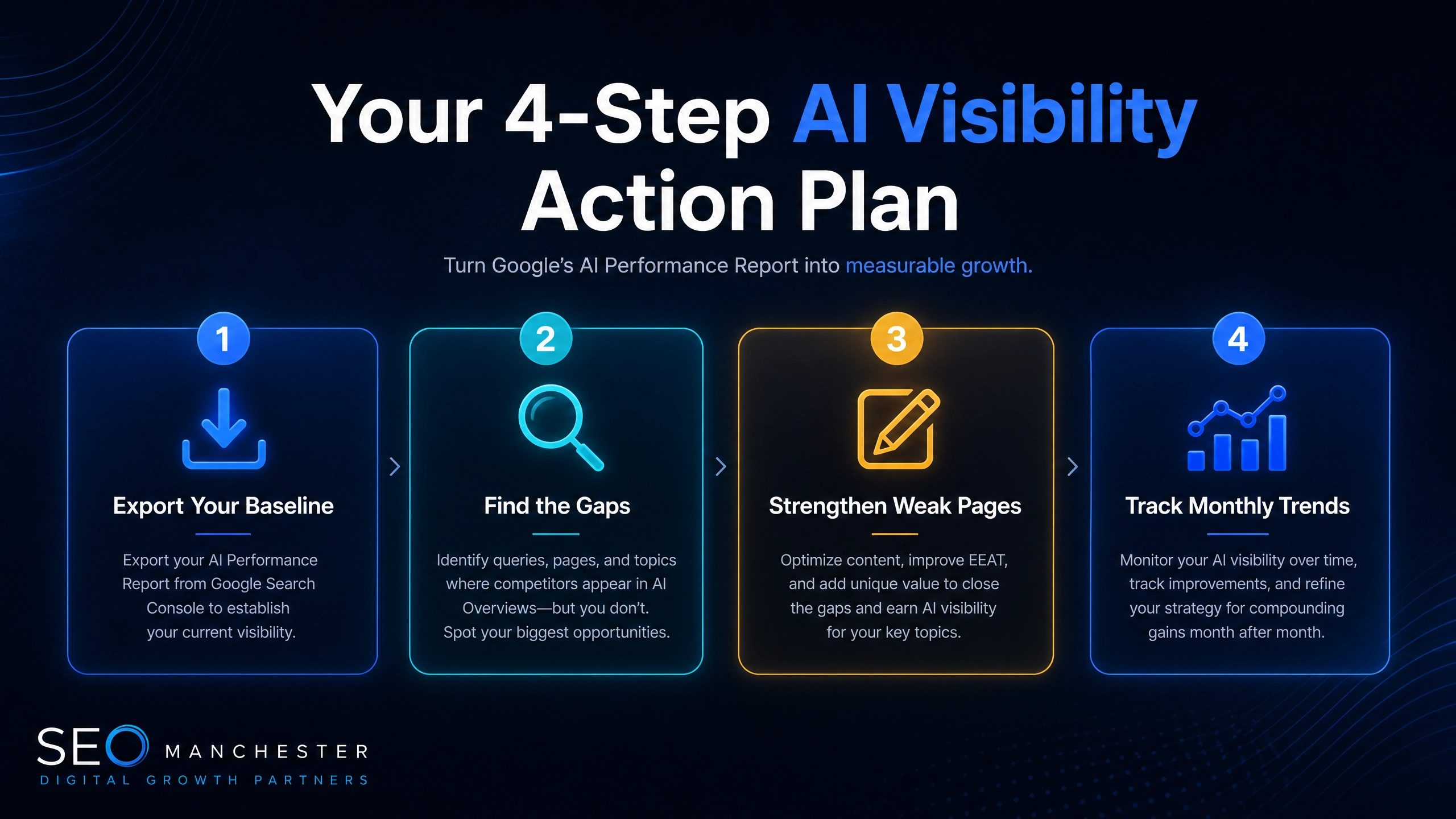
Having access to the Generative AI Performance Report is only valuable if you act on what it shows you. Here is the exact sequence we use with clients when their report goes live.
Step 1: Export your baseline before you change anything. Pull your current AI impressions by page now, while it is a clean "before" snapshot. You cannot prove improvement without a starting point, and the sooner you establish your baseline, the more useful your trend data will be. Export the data to a spreadsheet and date it clearly.
Step 2: Find the gap between organic rankings and AI visibility. This is the most valuable analysis in the report. Create a list of your pages that rank well in traditional search - position 1 to 10 for their target keywords - and compare it against the pages that appear in your AI report. The pages that rank organically but do not appear in AI answers represent your biggest opportunity. That gap almost always points to one of three problems: content structure that is not extractable by AI systems, missing or incorrect schema markup, or entity ambiguity - where Google's AI is not confident enough about what your page is about to cite it as an authority.
Step 3: Strengthen the pages that are already appearing. Read the pages that are earning AI impressions carefully. They are doing something right - clear answers, strong structure, genuine authority on the topic. Whatever those pages are doing, that is the pattern to extend across the rest of your site. Do not start by trying to fix your weakest pages; start by amplifying what is already working.
Step 4: Track monthly trends, not weekly snapshots. AI visibility data can be noisy in the short term, particularly in the early weeks of the report when Google's systems are still calibrating. Check your AI impressions monthly, compare them against your organic trend, and look for the divergences that tell the real story. Flat organic impressions combined with rising AI impressions means you are being pulled into answers even as click behaviour shifts - that is a positive signal. Strong organic performance combined with weak AI impressions means an extractability problem that is worth fixing as a priority.
How Think SEO Manchester Helps You Win in AI Search
At Think SEO Manchester, we have been optimising for AI-powered search as part of its search services - long before most agencies understood that AI Overviews were going to fundamentally reshape how businesses get found online. Our AI SEO and GEO service is built specifically around the signals that determine whether your content gets cited in AI answers: E-E-A-T, structured data, entity clarity, content extractability, and the technical foundations that allow AI systems to trust your pages as authoritative sources.
When the Generative AI Performance Report shows that a client's service pages are ranking organically but not appearing in AI answers, we know exactly what to fix. When it shows that a handful of blog posts are driving the majority of AI impressions, we know how to extend that pattern across the entire site. This is the kind of data-driven, AI-first SEO that separates businesses that grow in 2026 from those that watch their traffic erode.
If you are not sure whether your site has access to the Generative AI Performance Report yet, or if you have access but are not sure what the data is telling you, request a free SEO audit and we will check your AI visibility, identify your biggest gaps, and give you a clear action plan.
Frequently Asked Questions
What is Google's Generative AI Performance Report?
Google announced dedicated reports for generative AI features in Search and Discover on 3 June 2026 and confirmed worldwide rollout on 31 August 2026. They show impressions with page, country and date dimensions; device breakdowns are available for Search. Report visibility depends on sufficient impressions and the property's settings.
Does the Generative AI Performance Report show clicks?
No. The dedicated report currently provides impressions, not click, CTR or query data. Google is considering additional metrics over time but has not committed to a specific metric set or release date. Use the main performance report and analytics alongside it to assess traffic and enquiries.
How is AI visibility different from organic rankings?
Organic rankings measure where your pages appear in traditional blue-link search results, and success is measured in clicks. AI visibility measures whether your pages are cited inside AI-generated answers, and success is measured in impressions and brand exposure. A page can rank well organically but have zero AI visibility, or vice versa. In 2026, you need to track both.
Should I opt out of AI Overviews using the new toggle?
For most businesses, no. Opting out removes your content from AI Overviews, AI Mode, and Discover AI entirely, forfeiting all impressions and any traffic from those surfaces, with no benefit to your normal organic rankings. Unless you have a specific reason - such as protecting paywalled content - staying visible in AI search and optimising to be cited is the stronger strategic position.
How do I improve my AI impressions in Google Search Console?
The most effective improvements are: clear, direct answers near the top of each page; question-led H2 and H3 headings; strong E-E-A-T signals including real author credentials and specific data; properly implemented schema markup (FAQ, Article, Service); regular content updates to maintain freshness; and structured, extractable content formats. Our AI SEO service covers all of these as part of a comprehensive AI search optimisation strategy.
How quickly can I improve my AI visibility?
Content changes can start affecting AI impressions within days of publication, though the full impact typically takes two to four weeks to stabilise. Schema markup changes tend to be picked up faster. The key is to establish your baseline first, make targeted improvements to your highest-priority pages, and track the trend monthly rather than reacting to week-by-week fluctuations.
Sources: Google Search Central - Introducing Search Generative AI Performance Reports · Google Search Console Help - Generative AI Performance Report · Google Search Console Help - Search Generative AI Control · Nexvolu – Search Console Generative AI Report: AI Visibility 2026