AI Search in August 2026: Google’s Query Fan-Out, New Reporting and Spam Update Explained
AI search has moved from an experiment to part of the operating environment for every website. In August 2026, the most useful developments are not a new “hack” or a secret schema type. They are much more practical: Google has clarified how generative search retrieves sources, published official guidance for measuring AI visibility, and completed a global spam update that rewards substance over scaled noise. 1 2 3
For UK businesses, the implication is straightforward. A site needs to be easy to crawl, clear about what it knows, genuinely helpful to customers, and connected through sensible internal links. That is how it becomes eligible to be retrieved, understood and cited-not by filling a website with thin pages written for every imaginable prompt.

The August 2026 takeaway: Google says its generative features remain rooted in its core Search quality systems. Good SEO is still the foundation; the difference is that content now has to answer a wider set of related questions and earn trust as a source. 1
The three AI-search trends that matter right now
The most important story is not that “SEO is dead”. It is that AI search is changing how a user explores a subject. Google’s AI Overviews help users get the gist of a complex topic, while AI Mode is designed for exploration, reasoning and comparison. Both can surface supporting links, often through a process Google calls query fan-out. 1
At the same time, Google has given site owners an official way to study generative discovery in Search Console. Finally, the August spam update has closed-making this a sensible moment to check whether a site’s content strategy is built for people or merely manufactured for search visibility. 2 3
| Trend | What Google has confirmed | Practical implication for a business website |
|---|
| Query fan-out | AI features can issue multiple related searches across subtopics and sources. 1 | Build genuinely useful topic coverage rather than obsessing over a single exact-match keyword. |
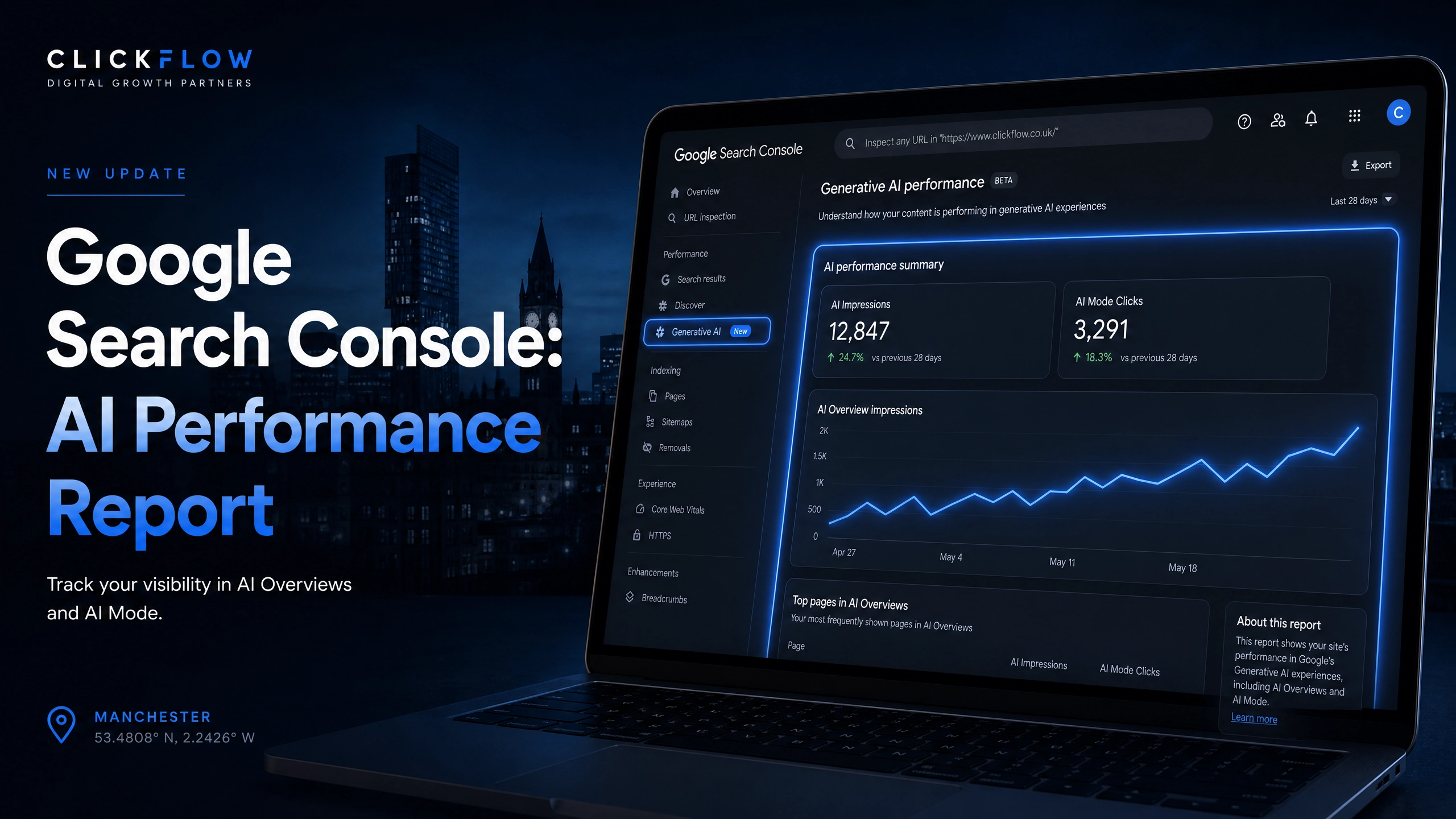
| Generative AI reporting | Search Console now includes a Generative AI performance report. 2 | Establish a baseline and compare AI discovery with organic performance and conversion quality. |
| August spam update | The global, all-language update ran from 18–21 August 2026. 3 | Audit for thin, repetitive or manipulative content before adding more pages. |
1. Query fan-out changes what “relevant” content looks like
In classic search, a user might type one short phrase and choose from a set of results. In generative search, a complex question can prompt several related retrievals at once. Google describes query fan-out as concurrent related queries used to gather more information and fetch additional relevant pages. 1
That does not mean a business should publish a separate page for every possible variation of a customer question. Google’s guidance is unusually direct on this point: creating pages for every possible fan-out query primarily to manipulate rankings can breach its scaled-content abuse policy. 2 4
Instead, create one complete, well-structured resource that earns its place in a customer journey. A good service page explains what is included, who it is for, the process, real constraints, proof, FAQs and what to do next. A good guide demonstrates first-hand judgement, not a rearranged summary of ten competitors.

What to change on your pages
Start with the questions that occur before a prospect is ready to buy. A building company might answer what a fire-door remediation project involves, how compliance is documented, the factors that affect cost, and how to choose a contractor. An accountant might explain the difference between two tax routes, who each option suits, and which records matter. The aim is not to be everywhere; it is to be reliably useful where a buyer is genuinely trying to understand a decision.
That is the logic behind a proper AI SEO strategy. It connects subject expertise, customer intent and technical clarity. It also creates natural opportunities to link from a guide to the relevant service page, a case study or an AI visibility audit-links that help people navigate and help Google discover the relationship between pages.
2. Google has made generative visibility measurable
Google’s current optimisation guide points website owners to the Generative AI performance report in Search Console as the official way to understand how people discover content through its generative features. 2 This is an important shift: AI visibility should be measured as part of an overall search and conversion picture, rather than guessed from ranking fluctuations alone.
The report should not become a vanity metric. Use it alongside organic impressions, clicks, leads, qualified enquiries, engagement and revenue. A cited article that produces high-quality visits may have more commercial value than a page that simply wins a large volume of unqualified traffic.

A sensible measurement routine
First, create a baseline. Record your existing visibility and conversion performance before making large changes. Then review the pages that receive generative discovery, asking what they have in common: depth, freshness, source quality, original expertise, images, a clear answer near the start, or a stronger technical foundation.
Next, compare that pattern with the pages that should be visible but are not. Do not immediately rewrite everything. Improve the page that has the best combination of commercial relevance and existing evidence. A technical SEO audit can identify crawl, rendering, canonical, schema and internal-link issues before you spend budget creating more content.
For a deeper walkthrough of the reporting change, see our guide to Google’s Generative AI Performance Report. The key point is that successful SEO is now measured across two connected outcomes: whether people can discover a source and whether that discovery ultimately leads to the right commercial action.
3. Original experience is becoming the most defensible advantage
Google’s generative AI guidance consistently returns to one phrase: valuable, non-commodity content. Google says a useful article should contribute a unique point of view, first-hand experience or material that goes beyond common knowledge. 2
This is good news for businesses that genuinely do the work. A clinician, contractor, solicitor, estate agent or marketing specialist has information that a generic content generator does not: real constraints, client questions, trade-offs, outcomes and recurring mistakes. Those are the ingredients of a source worth citing.

The editorial test to apply before publishing
Before a page goes live, ask four questions.
- Could a competitor swap in their logo and publish this unchanged? If yes, the content probably lacks a meaningful point of view.
- Does it answer a real question with evidence, examples or practical detail? Generalities do not earn trust.
- Can a user move naturally from this answer to the next useful page? Contextual links should reduce friction, not just repeat target keywords.
- Would the page still be worth reading if Google sent no traffic? This is the quickest way to separate customer value from algorithm-chasing.
Our content marketing service is designed around this standard: strong topical coverage built from real commercial questions, not bulk publishing. For businesses that want to test whether their current content actually strengthens their AI footprint, our free SEO audit is a useful starting point.
4. Technical structure still determines whether AI systems can use the page
Generative retrieval cannot rescue an inaccessible website. Google says a page needs to be indexed and eligible to appear in Search with a snippet before it can appear as a supporting link in AI Overviews or AI Mode. 1
That makes the technical basics non-negotiable: crawlable HTML, clear canonical signals, useful page text, mobile-friendly presentation, sensible information architecture, fast-enough page experience and accurate structured data that matches what a visitor can see. Google specifically lists internal links, high-quality supporting images and current business data among the established practices that continue to matter for AI features. 1

Internal linking: the quiet AI-search advantage
Internal links do more than distribute authority. They explain your site’s logic. A guide about being recommended in conversational search should link to how to get your business recommended by ChatGPT, then to the service that implements the work, then to the audit or contact route that helps a prospect act.
Likewise, a page about content quality should link to the relevant technical resource when it discusses crawlability, and a technical guide should link back to the commercial service for users who need help. This creates a clear, human-friendly route through the site. Google’s own AI-features documentation continues to identify internal links as a core SEO practice. 1
5. The August spam update is a warning against “AI content at scale”
Google confirmed that the August 2026 spam update applied globally and in all languages. It began on 18 August and completed on 21 August. Google did not publish new policy types alongside the release, so the right test remains its existing spam policies-not speculation about a hidden “AI penalty”. 3
The relevant policy for content teams is scaled content abuse. Google defines this as generating many pages primarily to manipulate rankings rather than help users, regardless of how the content is made. Its examples include using generative AI to make many pages without adding value, stitching together other pages without meaningful added value, and publishing pages that contain search keywords but make little sense to readers. 4

A better way to use AI in a content workflow
AI can speed up research, transcription, outlining, question clustering and editorial QA. It should not replace accountable expertise. The final page needs a real author, a clear purpose, accurate claims, original insight, sensible sources and a review by someone qualified to stand behind it.
That approach is both safer and more commercially useful. It means publishing fewer duplicate-looking pages and investing more in the pages that deserve to rank: high-value service pages, original explainers, useful local resources, case studies, proof and content that helps a customer make a decision.
If your traffic changed around a confirmed update, read our practical guide to the June 2026 spam update before making drastic changes. It explains the existing policy framework and the audit sequence we recommend.
A 30-day action plan for AI-search readiness
| Week | Priority | Outcome |
|---|
| Week 1 | Establish your Search Console baseline and check your key pages are crawlable, indexable and canonically correct. | You can identify real change rather than reacting to noise. |
| Week 2 | Choose one important topic and strengthen the page with original experience, direct answers, credible sources and relevant images. | A source page that deserves to be retrieved and cited. |
| Week 3 | Add or improve contextual internal links between guides, services, proof and conversion pages. | Clearer discovery paths for users and crawlers. |
| Week 4 | Review generative performance, leads and engagement; prioritise the most commercially valuable gap. | An evidence-led next sprint, not more undirected publishing. |
The practical goal is not to “rank in AI” as an isolated objective. It is to make your business easy to understand, easy to trust and genuinely useful when someone is researching a problem. That helps in AI features, classic Google results, local discovery and the decision a person makes after they land on the page.
Need a credible AI-search plan?
Think SEO helps UK businesses build a durable search presence across AI Overviews, AI Mode, classic organic results and local discovery. We focus on the work Google actually recommends: unique expertise, technical clarity, truthful structured data, strong internal information architecture and content that serves a real customer need.
Book a conversation with Think SEO to discuss the pages that matter most to your pipeline, or start with an AI Visibility Audit for a focused picture of your current strengths, gaps and next priorities.
References