Google Is Now Writing Your Ads For You: What AI-Generated Ad Summaries Mean for Your Business
On 1 July 2026, Search Engine Land reported that Google is testing something that should concern every business running Google Ads: AI-generated summaries displayed directly beneath paid Search ad descriptions -- written entirely by Google, not by the advertiser.
The feature was first spotted by digital marketer Darcy Burk, who shared a screenshot on X showing a standard Google Ad followed by a paragraph of AI-generated context. The summary carries a disclaimer that reads: "Google AI responses are generated independently and can make mistakes, so double-check responses."
Google confirmed the test with a statement: "This is a small experiment to see if adding AI-generated context to Search ads helps people make more informed decisions."
It is described as a small experiment. But for business owners and marketers who have spent years crafting precise ad copy, this development raises serious questions about brand control, messaging accuracy, and what happens when an AI decides to reinterpret your advertising.
Correction - 20 September 2026: A previous version of this article incorrectly described creating an llms.txt file as a high-impact technical change for Google AI Search. Google's current guidance says Google Search does not use LLMS.txt files, AI text files, special markup or Markdown to determine visibility in Google Search, including its generative AI features. Maintaining one for another service that explicitly uses it is fine, but it neither helps nor harms Google Search rankings or visibility. Read Google's official guidance.
What Is Actually Happening?
When a user searches on Google and triggers a paid ad, they would normally see the advertiser's headline, description lines, and any ad extensions. Under this new test, a third element appears beneath the ad: a paragraph of AI-generated text that Google believes provides helpful context about the product, service, or business being advertised.
The critical detail is that advertisers have no control over this content. Google's AI generates the summary independently, drawing on information it has gathered about the business from across the web -- its website, third-party reviews, directory listings, news mentions, and any other sources the model has indexed.
This means the AI summary could accurately describe your business. Or it could describe it incorrectly. It could highlight a service you no longer offer, quote a price you changed six months ago, or mention a competitor in the same breath. And it appears directly beneath the ad you are paying for.
Why This Matters Beyond Paid Ads
The immediate reaction from many advertisers will be concern about their PPC campaigns. That concern is valid. But the deeper implication of this development extends well beyond Google Ads.
This is the clearest signal yet that Google is moving towards a model where AI mediates the relationship between businesses and customers -- not just in organic search, but in paid search too. The AI is inserting itself into the conversation, adding its own interpretation of your business before the user has clicked anything.
For businesses that have invested heavily in brand messaging, tone of voice, and carefully crafted ad copy, this represents a fundamental shift. You can control what your ad says. You cannot control what Google's AI says about your ad.
The Brand Control Problem
Every word in a Google Ad is deliberate. Advertisers choose specific language to appeal to their target audience, differentiate from competitors, and comply with advertising regulations. A financial services firm, a healthcare provider, or a legal practice has particularly strict requirements around how their services are described.
An AI-generated summary that mischaracterises a regulated service, overstates a claim, or uses language the advertiser would never approve could create compliance problems -- even though the advertiser had no involvement in writing it.
Google's own disclaimer acknowledges this risk: "Google AI responses are generated independently and can make mistakes." That disclaimer protects Google. It does not protect the advertiser whose ad the summary appears beneath.
The Click-Through Rate Question
The stated purpose of the AI summaries is to help users make more informed decisions. In practice, this could go one of two ways.
If the AI summary is accurate and compelling, it could increase click-through rates by giving users more confidence before they click. A user searching for a Manchester SEO agency who sees an AI summary confirming the agency explains its services clearly and links to attributed client feedback may be more likely to click through.
If the AI summary is inaccurate, irrelevant, or simply adds noise, it could reduce click-through rates by diluting the ad's message or introducing doubt. A user who reads an AI summary that seems to contradict the ad's claims may choose not to click at all.
The net effect on CTR will vary by business, industry, and the quality of the AI's understanding of that business. Businesses with strong, consistent entity signals across the web -- accurate directory listings, verified review profiles, clear schema markup -- are likely to receive more accurate AI summaries. Businesses with thin or conflicting online information are at greater risk of inaccurate summaries.
What This Means for Your AI Visibility Strategy
This development reinforces a point we have been making to clients as part of its search services: the quality of your AI entity signals is now a commercial asset, not just an SEO consideration.
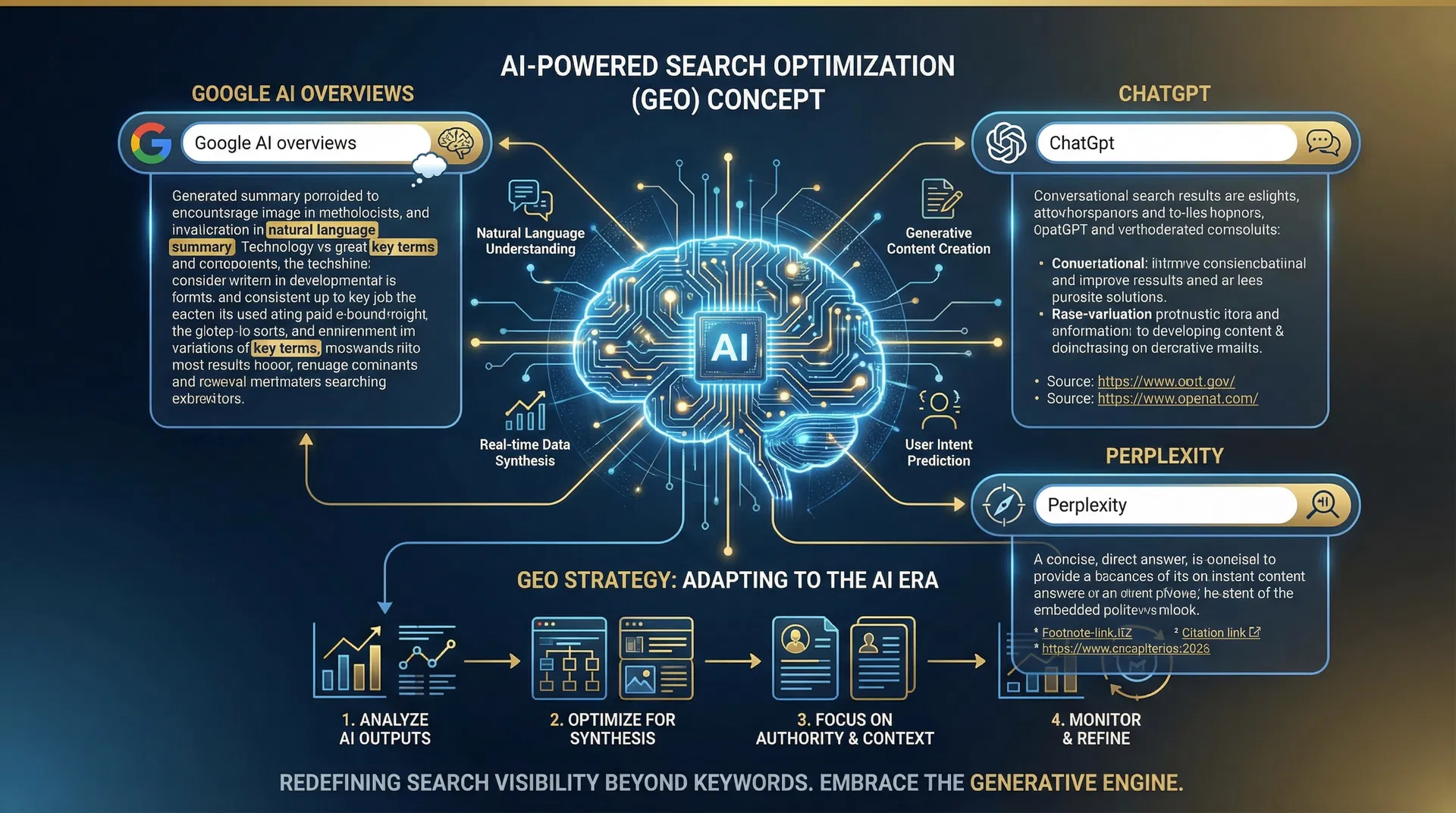
When Google's AI generates a summary about your business -- whether in organic AI Overviews, in ChatGPT search results, in Perplexity, or now beneath your paid ads -- it draws on the same pool of information. The businesses that control their AI narrative are those that have invested in making their entity signals clear, consistent, and authoritative across every platform where AI systems gather data.
The businesses that have not done this work are increasingly at the mercy of whatever the AI infers -- and as this new ad feature demonstrates, those inferences are now appearing in paid placements that cost money per click.
Five Things to Do Right Now
1. Audit what AI says about your business. Before you can fix your AI entity signals, you need to know what the AI currently believes about you. Run the ten prompts from our AI Search Reputation Audit guide across ChatGPT, Perplexity, Google AI, and Gemini. Document every inaccuracy.
2. Clean up your directory listings. Inconsistent NAP (Name, Address, Phone) data across directories is one of the primary causes of AI inaccuracy. Audit your listings on Google Business Profile, Bing Places, Yell, Yelp, Trustpilot, and any industry-specific directories. Ensure every listing is identical.
3. Strengthen your schema markup. Structured data in JSON-LD format tells AI crawlers exactly what your business is, what it does, where it operates, and who runs it. If your website lacks comprehensive Organization, LocalBusiness, and Service schema, AI systems are guessing. Our schema markup guide for AI SEO covers exactly what to implement.
4. Build third-party corroboration. AI systems gain confidence in information when multiple independent sources agree. A Clutch profile with verified reviews, a Trustpilot listing, mentions in industry publications, and engagement in relevant online communities all contribute to the AI's confidence in its description of your business.
5. Prioritise Google's actual foundations, not llms.txt. Google says it does not use LLMS.txt or other special AI files to rank or determine eligibility in Google Search, including AI Overviews and AI Mode. A file may be useful for another service that explicitly consumes it, but it is not a Google ranking tactic. Put the technical effort into crawlability, indexability, a clear site structure, accurate business details and helpful original content instead. Google's guidance is explicit.
The Broader Picture: AI Is Now in Every Layer of Search
Google's AI Overviews have been reshaping organic search since 2024. AI Mode is now available to over one billion users. And now AI-generated summaries are appearing in paid search results.
The pattern is consistent: Google is integrating generative AI into every layer of the search experience. Organic results, featured snippets, local packs, knowledge panels, and now paid ads -- all of them are being augmented or replaced by AI-generated content.
For businesses, this means that the traditional distinction between SEO (organic) and PPC (paid) is becoming less relevant. What matters increasingly is AI entity authority -- how well AI systems understand your business, trust your information, and represent you accurately across all search surfaces.
A business with strong AI entity signals benefits from accurate AI Overviews in organic search, accurate AI summaries beneath its paid ads, and accurate responses when users ask ChatGPT or Perplexity about its industry. A business with weak AI entity signals is at risk in all three.
What Think SEO Recommends
If you are currently running Google Ads, we recommend the following immediate actions:
First, monitor your ads closely for AI-generated summaries. Screenshot any that appear and assess their accuracy. If you see inaccurate summaries, document them -- this is evidence of the specific entity signal gaps you need to address.
Second, do not reduce your investment in ad copy quality. The AI summary is an addition to your ad, not a replacement. Strong, clear ad copy remains essential, and the AI summary may draw on your ad copy as one of its sources.
Third, treat this as an urgent prompt to invest in your AI entity signals. The businesses that will be least affected by AI-generated summaries -- and most likely to benefit from them -- are those whose AI entity signals are already strong, consistent, and authoritative.
If you are not sure where your business stands, our free AI visibility audit will show you exactly what AI systems currently say about your business and what needs to change.
The Bottom Line
Google testing AI-generated summaries in Search ads is not a minor feature update. It is a signal that AI is now embedded in every commercial layer of Google Search -- and that the quality of your AI entity signals directly affects the return on your advertising spend.
The businesses that invest in AI entity optimisation now are building a competitive advantage that will compound across organic search, paid search, and every AI-powered search surface that emerges over the next two years.
For a practical starting point, read our guide to what AI search reputation audits reveal about UK businesses, or contact us to discuss how Think SEO can help you take control of your AI narrative.
Source: Google tests AI-generated summaries in Search ads -- Search Engine Land, 1 July 2026.