Quick answer: local SEO for trades is about making the real business easy to choose
For a plumber, electrician, roofer, builder or specialist contractor in Greater Manchester, local SEO is not a collection of city-name pages or a promise to “get you to number one”. It is the practical work of making the business accurate, discoverable, understandable and credible when a nearby customer searches for a service.
That starts with an accurate Google Business Profile, a website that clearly explains each priority service, real-world project evidence, a simple route to call or request a quote, and a way to measure which enquiries turn into worthwhile work. It also means avoiding shortcuts: duplicate locations, invented addresses, bought reviews and thin pages that change only the town name.
The goal is not to force a ranking. Google says local results are shaped primarily by relevance, distance and prominence. No agency can responsibly promise a particular map position, AI answer or lead volume. What a well-run local SEO programme can do is remove avoidable uncertainty and build stronger evidence around the business a customer is deciding whether to contact. 1
This guide focuses on the work that is useful for trades businesses serving Manchester, Salford, Trafford, Stockport, Bolton, Bury, Oldham, Rochdale, Tameside and the wider Greater Manchester area. The same framework applies whether the business has a small team, multiple vans or a broader regional service footprint.
How local discovery works now
A customer does not always begin with the same search. They may type “emergency plumber near me”, compare “flat roof repair in Trafford”, ask a more conversational question in an AI-led search experience, or look for reassurance after finding a company through a recommendation.
Google describes three broad local-ranking factors:
- Relevance: how well the business information and page content match what the customer needs.
- Distance: how close the business or its service area is to the searcher’s location.
- Prominence: how established and well-known the business appears from information Google can verify, including links, reviews and wider online prominence. 1
That is why a strong local presence cannot rest on one tactic. A complete Google Business Profile cannot compensate for an unclear website. A polished website cannot fix an inaccurate service area. Five-star reviews are useful social proof, but they do not make a poorly explained service page answer a customer’s question.
For the wider commercial system behind this work, see Think SEO’s SEO for trades service. It covers the technical, local, content and conversion work that should fit together rather than live in isolated “SEO tasks”.
1. Set up the Google Business Profile around the real business
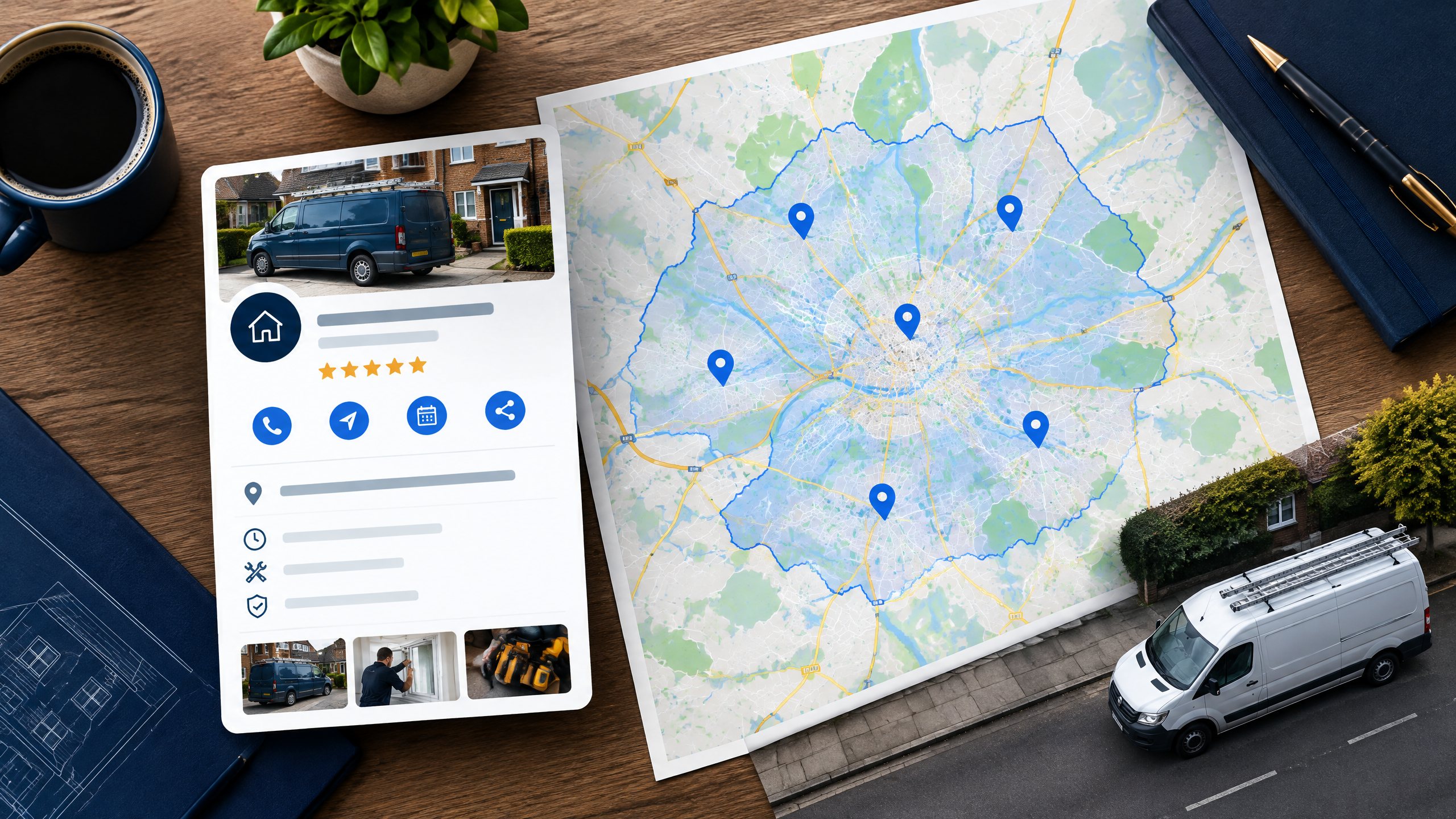
For many trades firms, the business is a service-area business: the team travels to the customer rather than receiving customers at a staffed public premises. Google explicitly uses plumbers and cleaning services as examples of this model. 2
The principle is simple: represent the business as customers experience it in real life.
A practical Google Business Profile checklist
| Area | What good looks like | What to avoid |
|---|
| Business name | The real-world name used on the van, invoices, website and customer communications | Adding location or service keywords to the name when they are not part of the real business name |
| Profile count | One profile for one genuine business | Extra profiles for every town, virtual office or operative |
| Address | A real address only where customers can genuinely visit during stated hours | Showing a home, mailbox or virtual-office address as a customer-facing location when customers do not visit there |
| Service area | Real cities, postcodes or districts the team actually serves | A vast catch-all radius or places that cannot be served reliably |
| Category and services | A primary category that describes the core business, then accurate service detail | Selecting every possible category in the hope of appearing for unrelated work |
| Photos and updates | Current, relevant work, team, vehicle and project imagery where appropriate | Generic stock imagery presented as a completed customer job |
Google says a service-area business may enter up to 20 service areas and that the overall boundary should generally remain within around two hours of travel from its base. It advises using cities, postcodes or other named areas rather than a radius, which can no longer be newly set or edited. 2
That does not mean every local page needs to list twenty places. The profile is an operational representation of where the business serves. The website should concentrate on the service information and local context that makes a customer more confident to enquire.
If the profile itself needs a focused review, our Google Business Profile optimisation service can assess the public information, categories, service-area setup and website alignment without inventing locations or making ranking guarantees.
2. Build service pages that help a customer choose
A local service page should not merely repeat “electrician in Manchester” or “roofer in Stockport” in slightly different wording. That approach creates a poor customer experience and can become thin, repetitive content at scale.
A stronger page answers the decision behind the search. For example, a roofing page may explain what signs warrant an inspection, how a survey works, which materials or repair options are appropriate, where the team can attend, what information helps when requesting a quote, and what evidence the business can show from relevant work. A bathroom-renovation page may explain the planning stage, trades involved, typical constraints, project galleries and how a homeowner can prepare for a visit.
The useful structure for a priority service page
- A plain-English service explanation. Say what the business does, who it is for and any important boundaries.
- The customer’s practical questions. Address suitability, process, expected information, access needs, materials, timing factors or common risks - only where the business can answer them truthfully.
- Relevant local context. Mention real coverage or examples naturally where they help a customer. Do not turn every sentence into a postcode list.
- Original proof. Use completed-work photographs, short factual project context, team experience or process detail that belongs to the business.
- A clear next step. Give the visitor a telephone number, form or quote route without making them hunt for it.
This structure is just as useful for conventional search as it is for AI-led search. Google’s guidance for its generative Search features says the foundations are still crawlable, indexable, technically clear and genuinely useful pages. It does not call for a special AI file, special AI schema or a page for every conversational keyword variation. 3
For a practical technical check, start with a free SEO audit. It is useful for identifying whether priority pages can be crawled, rendered and understood before adding more content.
3. Ask for reviews ethically - and use them as service insight
Reviews matter because customers use them to assess whether a trades business feels dependable. They can also support local prominence, but the value is not simply a higher count. A detailed, genuine review that describes a real service experience can help a prospective customer understand what working with the business is like.
The safe process is straightforward:
- Ask every genuine customer for an honest review after a completed job, at a suitable moment in the handover or follow-up process.
- Make the route simple: use the direct Google review link, but do not dictate the wording.
- Do not pay for reviews, offer discounts in exchange for them, write them on a customer’s behalf or filter the request so only expected positive feedback reaches Google.
- Reply professionally to reviews where appropriate. A response should respect privacy and avoid arguing in public about job details.
- Use recurring feedback to improve the service page, estimate process, job handover or customer communication - not merely as a badge on the homepage.
Google’s Maps policy prohibits fake or misleading content and reviews, and says it can take action where a harmful pattern exists. 4 A sustainable review programme therefore treats feedback as part of customer service rather than a volume target.
Think SEO’s guide to earning Google reviews as a trades business covers ethical review requests and practical profile hygiene in more detail.
4. Publish proof that customers can actually verify
In local trades markets, proof is often the difference between a page that is merely visible and one that earns the enquiry. A completed-project image, a brief explanation of the job scope, a clear portfolio entry or an accurate process page can answer the questions that generic marketing copy cannot.
That does not require publishing client addresses, sensitive pricing or private customer information. The objective is to make the claim proportionate to the evidence. A useful project entry might state the type of work, the broad area only if permission and relevance allow it, what problem was solved and what the customer needed next. It should never pretend that a single project proves every possible service outcome.
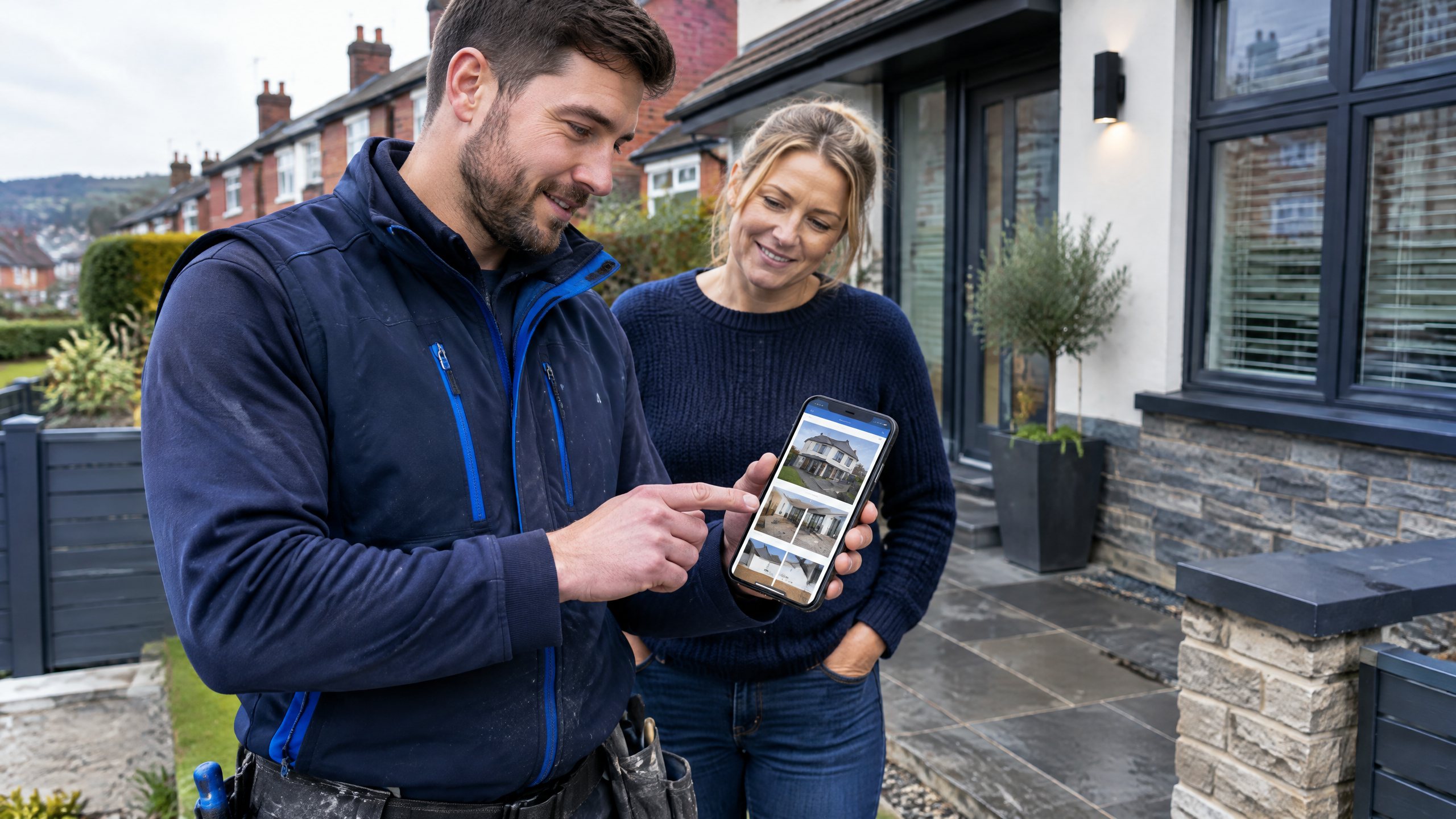
This evidence-led approach is also why case studies should distinguish clearly between work completed, observed visibility improvements and commercial outcomes reported by the client. See Think SEO’s Bury uPVC Spraying case study and South Coast Saunas case study for examples of how client-reported commercial results can be presented with appropriate context.
5. Make local pages technically easy to find and use
The most helpful service page cannot perform well if it is slow, difficult to use on mobile or isolated from the rest of the site.
For each priority page, check the following basics:
- It returns a normal 200 status rather than a redirect chain, soft 404 or blocked response.
- It has one preferred canonical URL and a unique, descriptive title and main heading.
- It is linked from a relevant service hub, navigation area, related project page or article - not left as an orphan.
- The key content, contact routes and business details are present in the initial response and do not rely only on a late JavaScript interaction.
- Images support the page and use useful alternative text; they are not unlabelled decoration or oversized files that delay mobile users.
- Telephone and form interactions are tested. A ranking or AI citation has little commercial value if the enquiry path fails.
Our technical SEO service covers crawlability, rendering, site architecture, canonical handling, structured data and page experience. These are important local SEO foundations, but they should support a useful customer journey rather than become a box-ticking exercise.
6. Where AI search fits for a Greater Manchester trades firm
AI-led search can change how some people research a job. A homeowner may ask which questions to ask a roofer, how to compare repair options, what causes a recurring plumbing issue or how to find a contractor for a particular kind of renovation. In some cases, an answer may include useful sources, images or local-business information before the customer visits a website.
The responsible response is not to promise that a trade business will appear in every answer. Google says its generative Search features are rooted in the same core Search ranking and quality systems, and that crawling, indexing and serving are never guaranteed. 3
Instead, make the information that matters easier to retrieve and verify:
- Explain the service in natural, practical language.
- Keep business identity, service area and contact details accurate.
- Publish original, relevant project evidence and useful service answers.
- Keep important pages accessible to crawlers and mobile visitors.
- Measure impressions, clicks, calls and qualified enquiries over meaningful periods.
This is the overlap between local SEO and AI SEO: clearer evidence, stronger technical access and better answers to real customer decisions. A free AI Visibility Check can provide a starting point for the AI-search readiness side of the review, but it is not a prediction or a guarantee of AI citations.
What to avoid in Greater Manchester local SEO
There are several tactics that create risk or waste time without making the business more useful:
- Duplicate Google Business Profiles for towns, virtual offices or team members who are not distinct public-facing businesses.
- Location doorway pages that swap “Manchester” for “Bolton”, “Bury” or “Oldham” without adding real service or customer value.
- Fake, paid or selectively gated reviews. Genuine feedback is slower but more defensible.
- Keyword-stuffed business names, titles, image alt text or profile descriptions.
- Invented AI-search methods, including special files or schema claimed to guarantee an AI answer.
- Untracked lead routes. If a business cannot see which calls, forms and projects are coming through, it cannot improve the work sensibly.
Local SEO should reduce ambiguity for the customer. If a tactic would make a homeowner feel misled after clicking through, it is not a durable strategy.
A practical 30-day local visibility plan
Days 1–7: confirm business facts
Audit the website footer, contact page, Google Business Profile, primary social profiles and any meaningful third-party listings. Confirm the real business name, telephone number, website, service scope and service-area or address display. Remove duplicates or inconsistencies carefully rather than changing every listing at once without a record.
Days 8–14: improve the pages that create enquiries
Pick three to five services that matter commercially. Check that each has a useful service page, clear contact route, relevant internal links and mobile-readable content. Start with the pages customers already ask about most often rather than a generic keyword list.
Days 15–21: add real proof
Collect appropriate project imagery, factual job context and customer-service feedback. Improve the pages with the evidence a customer needs to feel confident, not with filler designed only to lengthen the copy.
Days 22–30: set a baseline and review
Record Search Console visibility, Business Profile actions where available, calls, form submissions and qualified opportunities. Use that baseline to decide which service, area or technical priority needs the next iteration. This makes the next month’s work more accountable than chasing a screenshot of a single ranking position.
Download the Greater Manchester Trades Local Visibility Scorecard
Use this printable checklist with your team or during a website review:
Download the Greater Manchester Trades Local Visibility Scorecard (PDF)
If you would like help turning the scorecard into a prioritised plan, start with a free SEO audit or contact Think SEO. We can review the technical foundations, local-search information, page usefulness and AI-search readiness before recommending a realistic next step.
The bottom line
Local SEO for a Greater Manchester trades business is not a magic-profile setting or a set of templated town pages. It is the repeated work of making the real business more useful and easier to verify: accurate local information, clear service pages, genuine review practice, credible project proof, a fast accessible website and a practical enquiry route.
That makes the business more helpful to people, more legible to Search and better placed for the changing ways customers research local services. It is also the work that remains valuable whether the customer discovers the business through Google Maps, a traditional result, an AI-led answer or a word-of-mouth recommendation.
Frequently asked questions
Should a Greater Manchester trades business create a separate Google Business Profile for every town it serves?
No. Google’s guidance is to use one profile for a genuine service-area business, rather than creating extra profiles or addresses for places where the business does not genuinely operate. Build useful service and area information on the website when it helps customers, but do not create duplicate profiles or misleading locations.
How many service areas can a Google Business Profile have?
Google allows a service-area business to enter up to 20 service areas. It says the overall boundary should generally remain within about two hours of travel from the business base. Choose real cities, postcodes or areas you genuinely serve rather than using a broad, unrealistic radius.
Can a trades business offer rewards for Google reviews?
No. Google’s policies prohibit fake or misleading review activity, including paid reviews. Ask genuine customers for an honest review after completed work, without writing it for them, filtering only positive feedback or attaching an incentive to the review.
Does AI SEO guarantee that a trade business will appear in AI answers?
No. Google does not provide a guarantee or special AI shortcut. The useful work is still to make the site technically accessible, the service and location information accurate, the content helpful, and the evidence easy for a customer to verify.
What should a trades business fix first for local SEO?
Start with accuracy: one genuine business identity, the right contact details, an accurate Google Business Profile and clear service pages. Then add original project proof, improve the enquiry path and measure calls and qualified leads alongside search visibility.
References