Quick answer: Google AI visibility is still SEO - with a higher bar for usefulness
Google has not published a secret formula for getting a business “recommended” in AI Overviews or AI Mode. What it has published is more useful: a clear explanation that its generative Search features are built on the same core Search ranking and quality systems that already decide which pages can be retrieved and shown.
That means the job is not to find a new AI hack. It is to make the important parts of your business website easy to crawl, eligible to appear in Search, genuinely useful for a customer decision and accurately connected to the services, locations and proof that support that decision. Google’s May 2026 guidance and its July update put original, non-commodity content, technical clarity, relevant images and video, and accurate local business details at the centre of that work. 1 2
A necessary caveat: eligibility is not a guarantee. Google says a page must be indexed and eligible to show a Search snippet before it can be shown in its generative features, but crawling, indexing and serving are never guaranteed. The aim is stronger visibility and a more credible source - not a promised AI recommendation.
What changed in Google AI search guidance?
The practical change is clarity. On 15 May 2026, Google published its dedicated guide to optimising a website for generative AI features in Search. Rather than inventing a separate rulebook, the guide explains how normal Search systems supply relevant information to AI Overviews and AI Mode. 2
Google names two concepts that help business owners understand the opportunity:
- Retrieval-augmented generation (RAG), also called grounding: Google retrieves relevant and current pages from its Search index, then reviews information from those pages to create a helpful response with links to supporting sources.
- Query fan-out: for a complex question, the model can run several related searches at once to find information that helps answer the wider decision.
The implication is important. A customer may not search only for “Manchester builder” or “emergency plumber near me”. They may ask a broader question about suitability, process, local availability, cost factors, materials, credentials or what to expect next. A useful business source can help support that entire decision - but only if it adds real information beyond a generic rewrite of what is already available.

What “recommended by Google AI” really means
The phrase is understandable, but it can create the wrong expectation. Google does not offer a button, schema type or content template that makes it recommend a business. AI-generated answers are query-specific and can change with the question, the user’s context, the information available and the results Google retrieves at that moment.
A more responsible question is: does your site give Google enough clear, useful and trustworthy information to retrieve when a potential customer is researching the problem you solve?
For a local service business, that may mean a genuinely helpful service page, precise service-area information, photographs of relevant work, an accurate Google Business Profile, a clear explanation of the process and a straightforward way to enquire. For a B2B business, it may mean technical explanations, comparison guidance, specifications, real project context and a credible proof trail. The answer should fit the customer’s job to be done - not a made-up list of “AI keywords”.
The six foundations Google’s guidance supports
1. Make important pages crawlable, indexable and easy to use
Google’s first requirement is ordinary but non-negotiable: a page must be indexed and eligible to appear with a Search snippet. That puts the basics first: appropriate HTTP status codes, one clear canonical URL, accessible content, sensible internal links, mobile usability and a fast enough page experience.
This matters especially on JavaScript sites. Google can process JavaScript, but important page content should not depend on an interaction that a crawler or a slow device may miss. The visible service information, headings, contact details and supporting copy should all be available in a reliable first response. A focused technical SEO review should check these foundations before anyone attributes poor visibility to AI.
2. Replace commodity content with real information gain
Google’s strongest message is about content: unique, compelling, useful and non-commodity material is likely to matter more in the long run than any tactical shortcut. A generic page that merely restates common advice is easy for users and AI systems to replace. A page built from real experience is not.
For a trades firm, that could be the practical differences between two repair options, what a survey normally uncovers, images that show the work stages, or the questions a homeowner should ask before commissioning a job. For a professional firm, it could be an expert explanation of a difficult choice, a clearly scoped process or an anonymised example of common pitfalls. The goal is not to make every page longer. It is to make the important pages more useful.
Our content marketing service focuses on this kind of evidence-led content planning rather than volume for its own sake.
3. Answer the decision around the query, not every keyword variation
Query fan-out does not mean creating hundreds of near-identical pages for every possible related phrase. Google explicitly warns that creating separate content for every variation primarily to manipulate generative responses can fall into scaled content abuse. 1
Instead, map the genuine questions that a customer needs answered before they can choose a supplier. A good page can naturally cover the service, who it is for, the local context, the process, realistic constraints, evidence and the next step. That is useful to a person and gives Search a coherent source to understand.
For example, a useful page about SEO for trades should not be a city-name template. It should explain the work that matters to a trade business: technical accessibility, local visibility, project proof, service pages, enquiry routes and measurement. The content earns its place because it helps an owner make a decision.
4. Use relevant images and video as supporting evidence
Google’s generative features can surface relevant images and video as well as page links. Its image guidance recommends standard HTML images, relevant placement near supporting text, descriptive filenames and useful alt text - not keyword stuffing. 1 3
Visuals should add understanding. A contractor’s completed project gallery can support a service explanation. A short process video can make an unfamiliar service easier to assess. A diagram can clarify a technical comparison. Decorative stock imagery alone is not evidence, but it can still improve readability when it fits the content.

5. Keep local business details accurate wherever customers verify them
Google’s guide calls out local business and ecommerce details because generative responses can include business and product information where relevant. For a local company, start with accurate details on the site, then maintain the same practical information in the Google Business Profile and the public sources that genuinely matter to customers.
This is not an argument for creating artificial citations or manufactured mentions. It is about preventing avoidable confusion: the right business name, telephone number, service scope, address or service area, opening information where relevant, and current pages that explain what the business actually does. Accurate structured data can support the overall Search picture when it reflects visible page content, but it is not special “AI schema”.
6. Measure visibility and business outcomes together
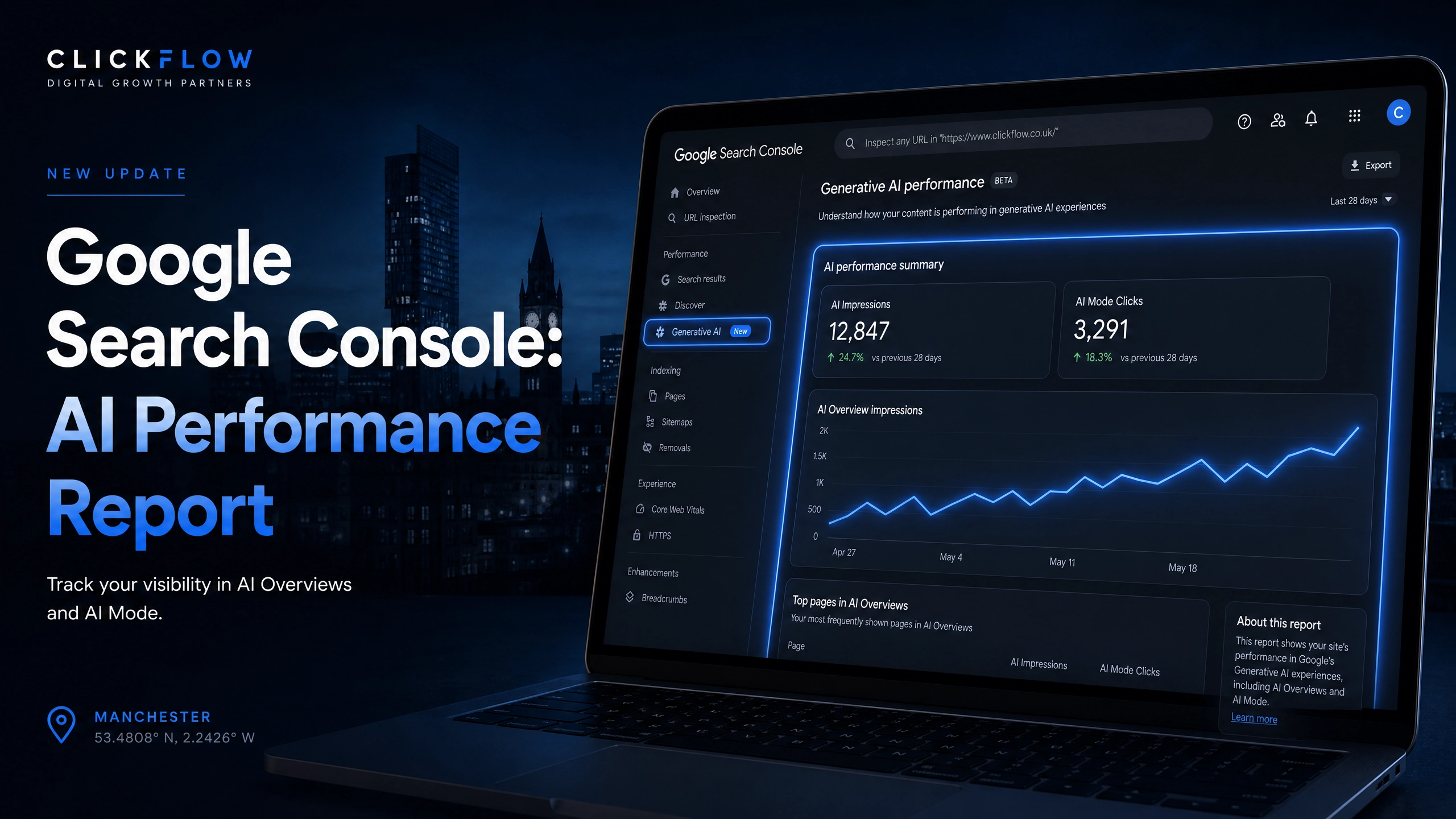
Google now provides a Generative AI performance report in Search Console. It can help show how content appears in generative features across pages, countries, devices and dates. That makes it a valuable diagnostic - particularly alongside the main Performance report - but not the only success metric. 1
Track the pages and queries that are commercially meaningful, then compare visibility with enquiries, calls, qualified opportunities and sales where that data is available. A change in clicks is not automatically a loss of value; it could reflect a different search journey, seasonality, a ranking issue, a tracking fault or a result layout change. Our detailed guide to the Generative AI performance report explains how to use the data without drawing premature conclusions.
What Google says you do not need to do
The most valuable part of the new guidance may be what it rules out. Google says it does not require:
- LLMS.txt files, special AI files or special markup to appear in Google Search generative features. They neither help nor harm Google Search visibility.
- A special schema.org type for AI search. Use accurate structured data where it supports normal SEO and eligible rich results, rather than inventing markup for AI.
- Artificial content chunking. Write and structure pages for readers; there is no required page length or fragment size.
- Exact-keyword rewrites for every conversational variation. Google can understand language, synonyms and intent.
- Inauthentic mentions or manufactured authority signals. These are not a durable route to quality visibility.
This is why Think SEO treats GEO as practical SEO for AI-led search, rather than a separate collection of files and promises. For the wider framework, read What Is Generative Engine Optimisation (GEO)?.
A practical 30-day Google AI readiness plan
There is no universal sequence, but this is a sensible starting framework for a small or medium-sized business:
- Choose three to five revenue-relevant pages. Start with the service, location or category pages that should create enquiries - not a vague site-wide keyword list.
- Check technical eligibility. Confirm the pages return the correct status, have a preferred canonical URL, are internally linked, render useful content and appear as intended on mobile.
- Audit the customer decision. Identify the questions that genuinely affect selection: suitability, process, constraints, location, evidence, pricing context or next steps.
- Add original proof. Improve the pages with experience, process detail, relevant project visuals, expert review or clear comparison material that a generic summary cannot replicate.
- Verify local clarity. Align the real-world details customers use to contact and evaluate the business; update the Google Business Profile where necessary.
- Set a baseline. Record Search Console impressions, clicks, important queries, leads and conversion signals, then review the Generative AI report over time.
If you would like a structured starting point, use the free AI Visibility Check for a practical readiness view, then book a conversation through Think SEO’s contact page if the findings point to a priority worth fixing.
The bottom line
Google AI search has not made SEO obsolete. It has made thin, derivative and technically unclear work less defensible. Google’s own guidance is clear: generative features still depend on the ability to retrieve useful, current, crawlable pages from Search.
The businesses best placed to earn relevant visibility are the ones that make their value easier to verify: a technically sound website, clear service and location information, original expertise, relevant visuals, credible proof and a page that helps a real person take the next step. That is work worth doing whether the customer sees an AI Overview, AI Mode or a classic blue link.
Frequently asked questions
Can Google guarantee that my business will be recommended in AI Overviews or AI Mode?
No. Google does not publish a formula or guarantee for appearing in generative AI features. A page must first meet normal Search eligibility requirements, and Google says crawling, indexing and serving are never guaranteed. The practical goal is to make the website technically accessible, genuinely useful and accurate for the customer decision.
Does Google AI search use different SEO rules?
Google says its generative Search features are rooted in its core ranking and quality systems. Strong conventional SEO remains the foundation: crawlable, indexable pages; useful original content; a clear technical structure; a good experience; and accurate business information.
What is query fan-out in Google AI search?
Google describes query fan-out as a set of concurrent related searches used to gather information for a complex question. It is not a reason to publish a separate page for every keyword variation. A useful page can address the decision around the topic with original experience and clear structure.
Do llms.txt files or special schema make a business appear in Google AI?
No. Google says it does not use llms.txt, special AI markup or a special schema type for visibility in Google Search generative features. Accurate structured data remains useful for normal SEO and relevant rich-result eligibility, but it is not an AI-search shortcut.
How can I measure visibility in Google AI features?
Use the Generative AI performance report in Google Search Console alongside the main Performance report, lead data and conversion data. Review the pages, queries and countries involved over meaningful periods before treating an AI feature as the cause of a business change.
References