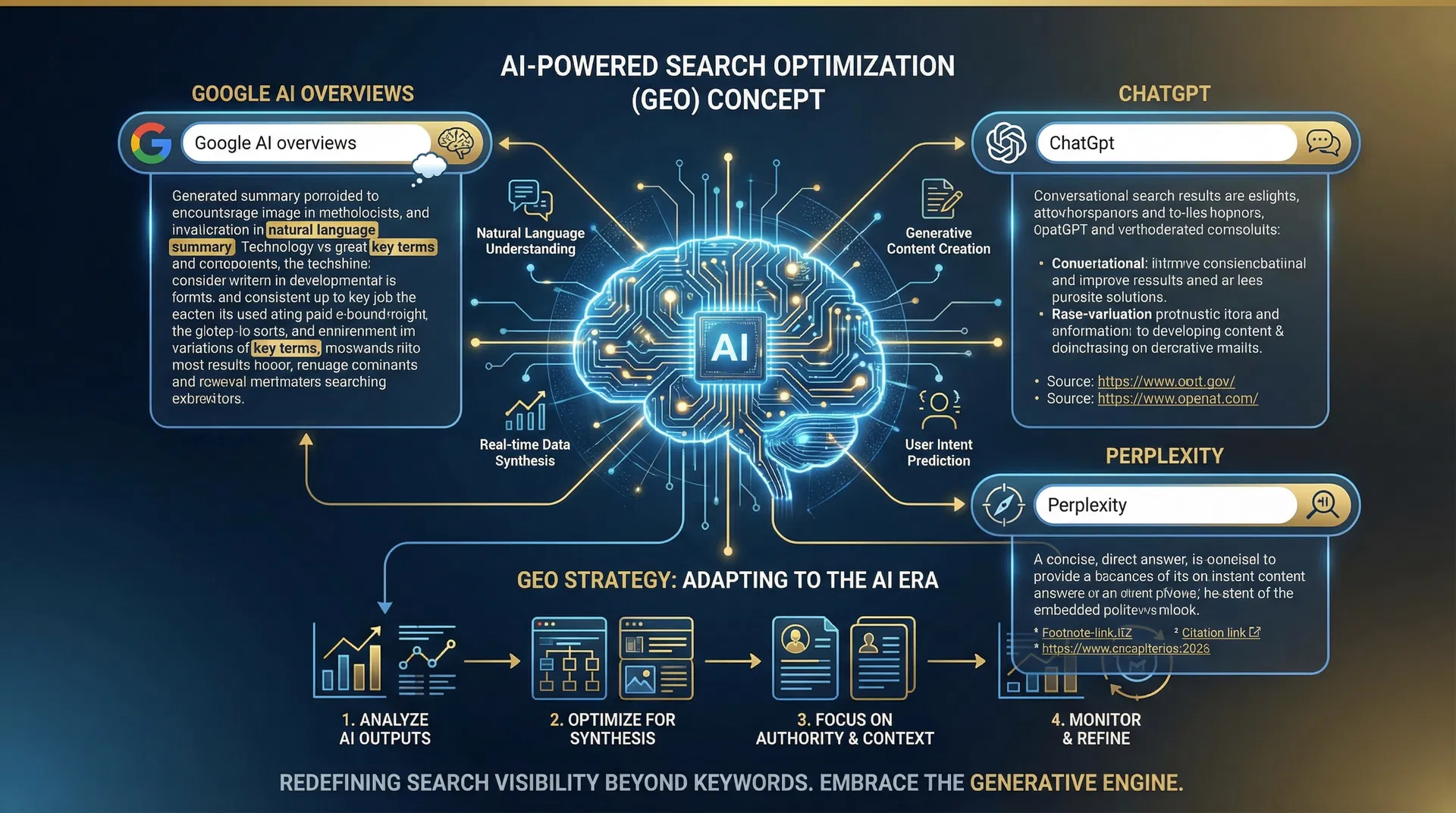
AI search is a legitimate traffic risk for some websites - but it is not a reason to panic, abandon SEO or assume that every fall in clicks is caused by ChatGPT or AI Overviews. The practical question is not “will AI take all our traffic?” It is: which customer questions are now being answered before a click, and where can our website still add enough value to earn the next action?
That distinction matters. A business can lose low-intent informational clicks while gaining more qualified visits, better calls or stronger brand recognition. Another business can see a genuine commercial decline because an AI answer now resolves a query that used to send it traffic. The only responsible response is to measure the difference and improve the pages that still matter to revenue.
The short answer: be alert, not alarmed
AI Overviews, AI Mode and answer engines are changing the route between a search and a website. They can answer a simple question on the results page, direct a user to a smaller set of sources, or help somebody refine what they want before they visit a business. This can reduce clicks for particular query types.
There is credible evidence that the risk is real. In a March 2025 study of US Google searches, Pew Research Center found that users clicked a traditional result on 8% of visits where an AI summary appeared, compared with 15% of visits where no AI summary appeared. They clicked a cited source in the summary on 1% of AI-summary visits. 1 That is an important warning signal - not a forecast for every website, every country or every query.
The sensible position: do not measure success only by a single traffic graph. Measure whether the right pages remain visible, whether the right people arrive, and whether they become qualified enquiries, calls or sales.

Why AI search can reduce clicks
The clearest risk is for searches where a person wants a quick, self-contained answer. If an AI feature summarises definitions, basic comparisons, opening times, generic troubleshooting or a simple list, the searcher may get enough information without choosing a traditional result.
Longer, question-shaped searches are particularly relevant. Pew found that AI summaries appeared more often for longer queries and questions: 53% of searches with ten or more words in its study produced a summary, as did 60% of searches beginning with words such as “who”, “what”, “when” or “why”. 1 That does not mean every question page will lose traffic. It means information-led journeys deserve closer attention.
For Google’s own generative features, the answer is grounded in pages retrieved from its Search index. Google describes this as retrieval-augmented generation, and explains that its systems may also run related searches through query fan-out to gather more relevant information. 3 The opportunity is therefore not simply to rank for one wording; it is to publish a source that helps resolve the surrounding decision.
What the click data does - and does not - tell us
It is tempting to treat an AI Overview as a straight substitution for organic traffic. The evidence does not support that simple conclusion. Pew’s study examined US adults on tracked devices during one month in 2025, and it compared behaviour on searches where an AI summary appeared with behaviour on searches where it did not. Different query types can naturally have different click behaviour, and the study does not measure any individual site’s revenue, lead quality or long-term brand impact. 1
That is why a business should not use an industry statistic as proof that its own traffic has been “cannibalised”. Start with your data instead. Did impressions fall, or only clicks? Did the affected queries become more answerable on the results page? Did a specific landing page lose visibility, or did seasonality, a site change, tracking error or a ranking loss occur at the same time?
Google has now made that investigation easier. Its Generative AI performance reports in Search Console show impressions, pages, countries, devices and date trends for URLs appearing in generative AI features in Search and Discover. Google completed the worldwide rollout on 31 August 2026. 2 Use the report as a visibility diagnostic alongside the main Performance report - not as a replacement for conversion and lead data.
A practical way to diagnose your own exposure
Begin with a 90-day baseline, then compare like-for-like periods. Look at the queries and landing pages that matter commercially, rather than blending every blog visit into one total. A detailed technical SEO audit can help validate that tracking, indexation, redirect behaviour and crawlability are sound before a change is attributed to AI.
Check whether visibility, clicking or conversion changed
If impressions and clicks both fall, the first question is whether search demand, rankings or indexation changed. If impressions hold but clicks fall, a changing result layout or answer-led search journey may be a stronger hypothesis. If visits fall but phone calls, form submissions or qualified opportunities hold, the lost traffic may have been less commercially useful than it looked.
Segment the pages by intent
Separate quick-answer pages from service pages, comparison pages, case studies, location pages and transactional journeys. A one-sentence definition behaves differently from a guide that helps a buyer compare options, assess risk or choose a supplier. The right response to an informational click decline might be a clearer next step, not a desperate rewrite of the page.
Review the generative AI report alongside organic search
Use Search Console’s Generative AI report to identify which pages appear in those features, then compare that visibility with clicks and conversions. A page can create value by being introduced to a user early in their research even if the first interaction is not a direct enquiry. You need the broader journey to judge that value properly.

What should businesses do now?
The weak response is to produce large volumes of generic AI-focused pages or chase every supposed “citation hack”. The stronger response is to make the site more useful where customers still need judgement, proof and a next step.
Strengthen the pages closest to revenue. A service page should make the offer, process, suitability, evidence and contact route clear. It should answer a customer’s sensible questions without forcing them to hunt across the site. Our guide on what happens after a new website launches explains how technical validation, on-page relevance, authority and measurement work together after the build is complete.
Add information gain, not filler. Google recommends useful, non-commodity content that brings a distinctive point of view rather than recycling what is already widely available. 3 Share real process knowledge, clear qualifications, locally relevant context, transparent comparisons and evidence-led case studies. A resource that helps a user make a difficult decision is more valuable than a generic definition that any tool can reproduce.
Make it technically straightforward to retrieve the page. Important pages need crawlable content, sensible internal links, an accurate canonical URL and a good mobile experience. Google says that eligibility for generative features depends on the normal technical requirements for being indexed and shown with a Search snippet. 3 That is why AI SEO starts with conventional technical and content foundations instead of treating AI visibility as a separate trick.
Link information to action naturally. An article should have a useful route to the service, guide, proof or tool that genuinely helps the reader next. For a practical starting point, try Think SEO’s free AI Visibility Check or use the more detailed AI Visibility Checker. The purpose is a better customer journey, not artificial link volume.
Where the opportunity is still strong
AI-led discovery can also introduce a business to people who may not have used the old keyword search journey. Google says generative Search can reach people who are more inclined to engage, spend time with content or convert. 3 The task is to be a good source when those people explore the answer further.
That is especially relevant where the decision needs nuance: choosing a supplier, comparing technical options, checking a service area, understanding a process, assessing credentials or moving from research to a quote. AI may accelerate the first stage of research, but it cannot replace the business’s own clarity, proof or ability to handle a real customer conversation.
For Think SEO clients, the goal is not to protect a vanity traffic number at all costs. It is to preserve and grow meaningful discovery: visibility for the right services, accurate AI representation, useful content that builds trust and a website that converts attention into business.

The bottom line
Yes, AI search can take clicks away from some types of content. The evidence makes that worth monitoring. But a decline in clicks alone is not a diagnosis, and it is not a reason to chase a new wave of spammy AI tactics.
The best response is disciplined: check technical health, use Search Console to identify affected queries and pages, measure leads as well as visits, improve the original usefulness of high-value content and give every important page a clear route to the next action. For a broader view of the changing landscape, read our AI Search Trends guide or contact Think SEO for a practical review.
Frequently Asked Questions
Are AI Overviews reducing website traffic?
They can reduce clicks for some search journeys, especially where a user’s question is answered on the results page. The impact is not universal: it depends on the query, search result layout, audience, page type and whether the site is cited or still offers a valuable next step.
Should we stop creating informational content because of AI search?
No. Make information genuinely useful, original and connected to a relevant next action. Content that answers a question well can still build trust, support discovery and create qualified enquiries even when not every search produces a click.
How can we see whether AI features affect our Google traffic?
Use Google Search Console to compare impressions, clicks, queries and landing pages over meaningful periods. Google’s Generative AI performance reports can also show impressions and pages appearing in its generative features, helping separate a visibility change from an assumed traffic loss.
Does ChatGPT traffic replace Google organic traffic?
Not necessarily. ChatGPT, Google AI features and normal Google results are different discovery routes with different user behaviour. Measure each source and the enquiries it produces before deciding whether one is replacing another.
References